
Fast Facts
| National Regulator | Energy and Water Regulatory Commission (EWRC) |
| Licence Lead Time | Approximately 3 months |
| Application Fee | Approximately EUR 500 |
| Issuance Fee | Approximately EUR 7,700 |
| Annual EWRC Contribution | Approximately EUR 1,022 plus 0.055% of annual gas-trading revenues |
| Licence Duration | Typically 10 years; maximum 35 years |
Bulgaria Gas Market Fundamentals
Bulgaria's natural gas market is partially liberalised and aligned with EU rules. Wholesale trade and supplies to industrial end-users are open to competition, while household supply and network operations remain regulated.
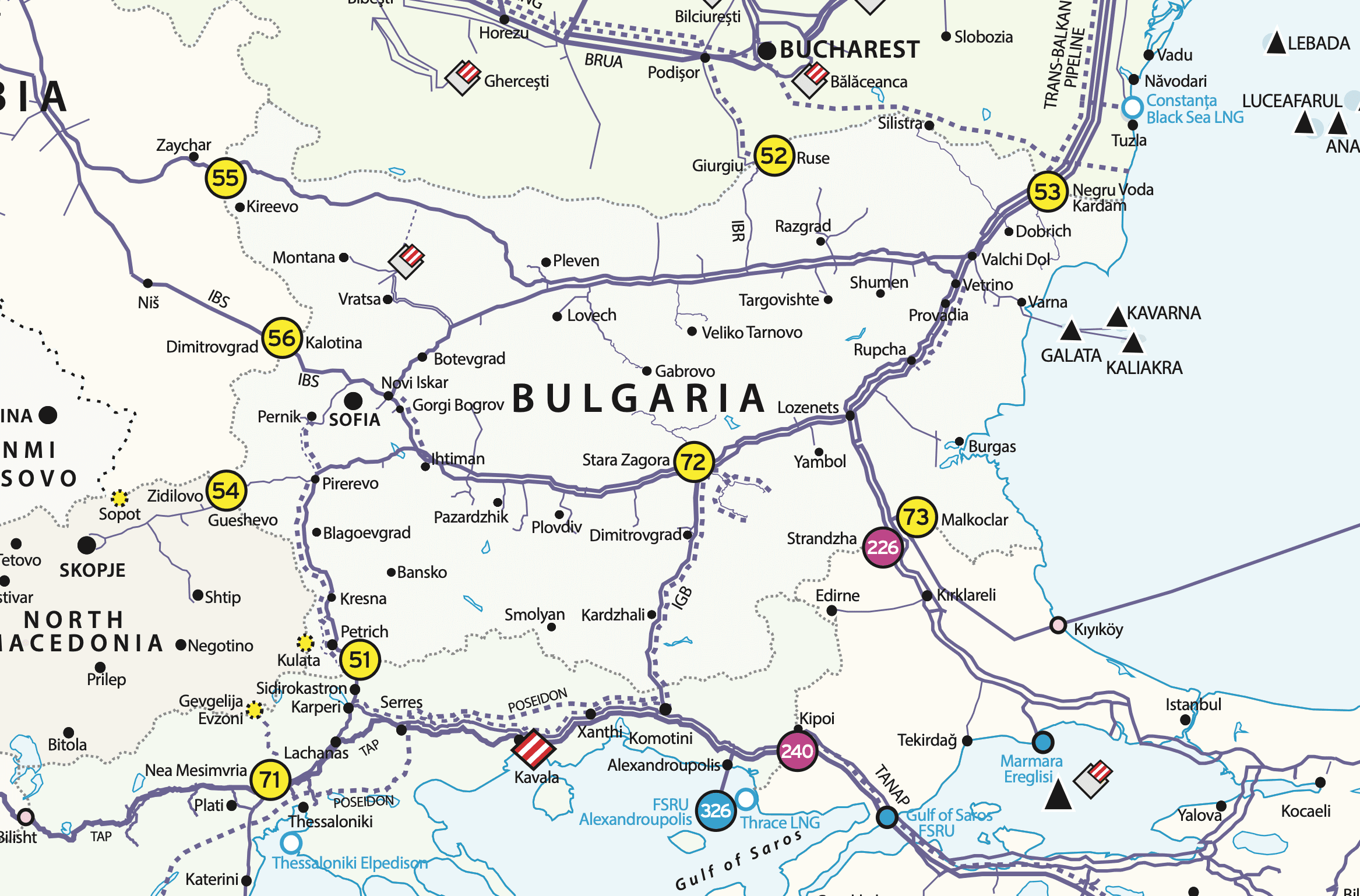
The country is a strategic transit point for Southeast Europe and a central link in the Vertical Gas Corridor.
Bulgaria imports over 99% of its natural gas, with domestic production negligible.
Supply has diversified toward Azerbaijani piped gas, covering around 30% of domestic consumption, alongside LNG delivered via the IGB interconnector and Greek LNG terminals Alexandroupolis and Revithoussa.
The majority of gas transported through the national system, around 86%, is transited to neighbouring countries, primarily Serbia, Greece and Romania.
When Is a Licence Required in Bulgaria's Gas Market?
Wholesale, retail, import, export and transit activities require a gas trading licence from the Energy and Water Regulatory Commission (EWRC). The application is submitted in hard copy on approved forms and typically takes around three months from a complete dossier.
Natural gas imports are subject to prior authorisation from the Bulgarian Customs Agency; for non-Russian gas, applications must be submitted at least 5 working days before entry (7 working days for the Strandzha 1 interconnection point).
Short-term standardised products, including day-ahead and within-day products, must be traded on an organised exchange such as BGH or BETP.

What Are Bulgaria's Gas Market Licence Requirements for EU and Non-EU Entities?
EU and EEA commercial companies must obtain an EWRC gas trading licence, covering wholesale, retail, import and export activities. They do not need to establish a Bulgarian subsidiary or branch. Passporting of EU licences is not available in Bulgaria.
Non-EU companies need a Bulgarian legal presence and must obtain a Bulgarian gas trading licence for wholesale trading and import/export; they cannot rely on an EU licence or passporting.
All traders must also contract with the relevant market operator(s) and TSO, comply with balancing and network rules, and meet applicable customs, tax and regulatory obligations.
Balancing in the Bulgaria Gas Market
Bulgartransgaz EAD operates the national transmission system as a single balancing zone with one Virtual Trading Point.
Traders must sign a balancing agreement with the TSO, manage their portfolios and pay daily imbalance charges for deviations.

Transmission Capacity in the Bulgaria Gas Market
Physical and commercial transmission rights at interconnection points are allocated through the Regional Booking Platform under the TSO's auction rules.
Standard firm and interruptible products include annual, quarterly, monthly and day-ahead capacity.
Special Route 1, Route 2 and Route 3 products support transit from Greece through Bulgaria to Romania, Moldova and Ukraine on a time-limited basis.
Shippers need the EWRC licence, Bulgartransgaz access approval and an access and transport contract before participating.
Bulgaria Gas Market Exchange(s)
The Balkan Gas Hub (BGH), operated by Bulgartransgaz, is the main gas trading platform and offers spot and forward contracts.
The Bulgarian Energy Trading Platform (BETP), owned by the Romanian Commodities Exchange (BRM), is the main competing organised marketplace for standardised gas products.
Longer-term bilateral arrangements may be traded over the counter. Organised-market gas trading has grown steadily, with more than 100 registered participants and over 42 TWh traded.
5 Market Entry Steps for Bulgaria Gas Market
- 01Obtain an EWRC gas trading licence.
- 02Sign Bulgartransgaz agreements for transmission and VTP access.
- 03Register for capacity booking on RBP and book cross-border capacity.
- 04Register with BGH or BETP for spot and forward gas trading.
- 05Set up bilateral OTC trading.
- Post-Market Entry Reporting Obligations.
CorreggioNET, Bulgaria Gas Market Access Report
Market Access Reports: CorreggioNET offers Pre-Market Entry Reports (PMER) as part of the PMER Library, providing firms with an A-to-Z guide for market entry.
CorreggioNET Alert Service: Helps you never miss a reporting obligation. Note that Bulgaria has multiple gas market reporting obligations, including towards EWRC, Intrastat, etc., combined with high regulatory volatility. The Alert Service ensures you never miss a deadline.
CorreggioNET Hotline: For your time-sensitive queries, the Regulatory Hotline Service provides direct support through an online interaction with a qualified regulatory specialist.
Consulting Solutions: For those firms which require additional assistance, Correggio Consulting is on hand to assist with all your licensing needs:
- Market entry & registration in Bulgaria;
- EWRC Trading License;
- Bulgartransgaz TSO onboarding;
- BGH or BETP exchange onboarding;
- Corporate structuring;
- EFET contract negotiation;
- Yearly compliance audits.

Market Info
Stay Compliant After Market Entry
Entering a new market is only the beginning.
Once trading activity starts, the real challenge is staying compliant with ongoing regulatory updates and reporting obligations. CorreggioNET supports this post-market entry stage through its regulatory platform and monitoring services.
See platform services