
Fast Facts
| Application Fee | EUR 995.42, plus an annual variable fee of 0.05% of gas sales income |
| EU Simplified Route | EU licence holders use a simplified procedure with no registration in Croatia required for licensing |
| Regular Procedure Finance | Legal persons EUR 2,654.46, physical persons EUR 265.45, as an average 30-day balance, maintained for the licence term |
| Processing Time | 30 days from complete application, or 60 days where additional steps are needed |
| Initial Licence Term | Issued for 1 to 15 years; in practice initial gas trading licences have been issued for 3 years |
| LNG Capacity | Krk LNG terminal maximum regasification capacity increased to 6.1 bcm/year |
Croatia Gas Market Fundamentals
Croatia's gas trading, supply and production are market-based, while transmission, distribution, storage, LNG and market operation remain regulated.
The virtual trading point (VTP) is the wholesale venue, open only to balance responsible parties, with multiple active BRPs currently serving the market. HROTE's platform registers VTP trades and handles TSO balancing, but does not function as a full anonymous exchange.
The Krk LNG terminal supplies the majority of Croatia's gas imports. Following completion of its expansion, the terminal has a maximum regasification capacity of 6.1 bcm/year, strengthening Croatia's role as a regional LNG hub for Central and Southeast Europe.
Domestic production meets roughly one-quarter of demand, with the remainder supplied through imports. The wholesale market is moderately concentrated, led by PPD.
When Is a Licence Required in Croatia's Gas Market?
Wholesale gas trading is a licensed energy activity requiring a licence from HERA.
A gas trading licence covers wholesale activity only; a gas supply licence covers both wholesale and retail supply to end buyers.
Applicants must pass three tests: technical (business premises), professional (experienced staff or a contracted service company), and financial (a set average bank balance over the preceding 30 days). Under the regular procedure, legal persons hold an average balance of EUR 2,654.46; physical persons, EUR 265.45.
Registration in Croatia for the gas trading activity is required for licensing unless the applicant holds an EU energy licence for the same activity. Separately from licensing, whether an entity conducting regular and permanent business in Croatia must establish locally is assessed case by case.
Processing takes 30 days from a complete application, or 60 days where HERA undertakes additional steps.
Licences are issued for 1 to 15 years; in practice, initial gas trading licences have been issued for 3 years.

What Are Croatia's Gas Market Licence Requirements for EU and Non-EU Entities?
Holders of an EU energy licence can use HERA's simplified procedure: no registration in Croatia is required for licensing, and submission is limited to a trade registry extract, statements from responsible persons, and a security instrument (a bank guarantee or monetary deposit). HERA may contact the home-State regulatory authority to confirm the applicant's qualification and checks the EU register of market participants.
Applicants that cannot rely on the simplified EU procedure, including non-EU traders, must be registered in Croatia for the gas trading activity and satisfy the full technical, professional and financial qualification requirements.
Balancing in the Croatia Gas Market
Croatia implements Regulation (EU) 312/2014 through HROTE's Gas Market Rules and Plinacro's Grid Rules.
The market is organised around balancing groups, each led by a BRP. Only a gas supplier or trader may act as BRP, and only for one group at a time. The BRP harmonises daily quantities entering and exiting the system, minimising the balancing the TSO must undertake.
Where the system remains in imbalance, Plinacro corrects the residual by buying or selling short-term gas on HROTE's platform. Marginal purchase and sale prices are set for each gas day and published by HROTE, with deviation fees delivered to the BRP by 16:00 on the third working day after publication of the final report.
Transmission Capacity in the Croatia Gas Market
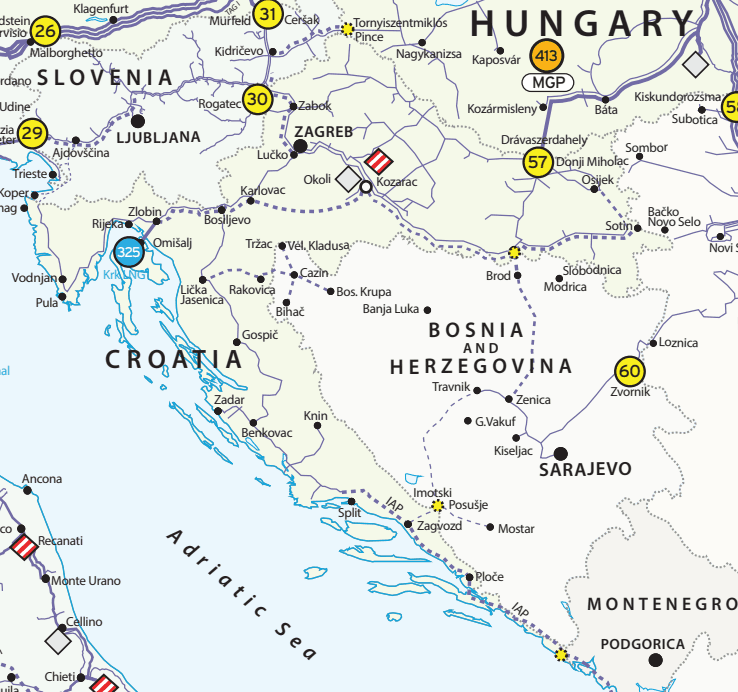
Croatia connects to Slovenia and Hungary, with interconnection capacity auctioned through PRISMA and RBP. The Transport Agreement covers domestic entries and exits, while the INT Transport Agreement covers interconnections.
Standard capacity products are available as annual, quarterly, monthly and daily at all points, with intraday products also available at interconnections. Applications to conclude the agreement must be submitted at least 10 days before the capacity booking application deadline, with a TSO response within 2 working days, and the signed agreement returned at least 5 working days before that deadline.
Capacity can also be transferred on the secondary market, by contract or right of use, subject to TSO approval and, for coupled capacity, approval from the TSOs on both sides of the interconnection.
Croatia Gas Market Exchange(s)
Croatia has no organised gas exchange; CROPEX operates in electricity only. The virtual trading point (VTP) is the wholesale venue, open only to BRPs.
Trades are agreed bilaterally between two BRPs, then confirmed through HROTE by a daily report of EIC codes, gas days and quantity. HROTE and the TSO do not mediate the trades themselves.
HROTE's platform serves two functions: logging bilateral VTP trades and providing a platform for balancing transactions with the TSO.
5 Market Entry Steps for Croatia Gas Market
- 01Obtain the HERA gas trading licence, using the EU simplified procedure (if applicable).
- 02Register as BRP with HROTE, sign the HROTE Agreement and post security within 10 days, then conclude the Agreement on Access to the Gas Market Operator's Information System.
- 03Sign the Transport and/or INT Transport Agreement and the SUKAP Agreement with the TSO Plinacro.
- 04Register on PRISMA or RBP and book capacity.
- 05Contract storage or LNG capacity where required.
- Post-Market Entry Reporting Obligations.
CorreggioNET, Croatia Gas Market Access Report
Market Access Reports: CorreggioNET offers Pre-Market Entry Reports (PMER) as part of the PMER Library, providing firms with an A-to-Z guide for market entry.
CorreggioNET Alert Service: Helps you never miss a reporting obligation. Note that Croatia has multiple gas market reporting obligations. The Alert Service ensures you never miss a deadline.
CorreggioNET Hotline: For your time-sensitive queries, the Regulatory Hotline Service provides direct support through an online interaction with a qualified regulatory specialist.
Consulting Solutions: For those firms which require additional assistance, Correggio Consulting is on hand to assist with all your licensing needs:
- Market entry and licensing in Croatia;
- HERA licence application, including the EU simplified procedure;
- HROTE BRP registration and Plinacro SUKAP onboarding;
- PSP storage and Krk LNG terminal capacity contracting;
- Corporate structuring;
- EFET contract negotiation;
- Yearly compliance audits.

Market Info
Stay Compliant After Market Entry
Entering a new market is only the beginning.
Once trading activity starts, the real challenge is staying compliant with ongoing regulatory updates and reporting obligations. CorreggioNET supports this post-market entry stage through its regulatory platform and monitoring services.
See platform services