
Fast Facts
| Minimum Financial Resources | No statutory minimum |
| Application Stamp Duty | PLN 616, approximately EUR 140 |
| Annual OEE Licence Fee | 0.05% of revenues, minimum PLN 1,000 (approx. EUR 230) and maximum PLN 2,500,000 (approx. EUR 580,000) |
| Total Consumption | Around 169,000 GWh |
| Largest Energy Source | Hard coal, around 41% |
| Net Position | Net importer, around 2,000 GWh per year |
Poland Power Market Fundamentals
Electricity trading operates in a liberalised and EU-integrated market regulated by URE.
Poland is integrated into the EU's coupled day-ahead and intraday markets through three exchanges: TGE, EPEX SPOT and Nord Pool.
The generation mix remains coal-heavy, with hard coal around 41% and lignite around 21%, while renewables are expanding quickly and offshore wind projects have entered the construction phase.
A structural phase-out is underway, with several GW of coal-to-gas switching planned and the first nuclear plant expected online.
When Is a Licence Required in Poland's Power Market?
An OEE electricity trading licence from URE (Urząd Regulacji Energetyki) is mandatory for wholesale and retail market participants. Polish law does not distinguish between wholesale traders and end-consumer suppliers for this licence.
Poland does not offer EU licence passporting, so entities licensed elsewhere in the EU still need to obtain their own Polish OEE licence.
Applicants may also request a licence promise (promesa) as an interim step, valid for at least six months and requiring a shortened set of appendices; it helps secure financing for a planned investment but does not by itself confer the right to trade.
What Are Poland's Power Market Licence Requirements for EU and Non-EU Entities?
EU Entities: Companies with a registered office in an EU Member State, Switzerland, EFTA/EEA or Türkiye can apply directly for a Polish OEE licence without a local branch, submitting equivalent registration documents translated into Polish by a sworn translator.
Non-EU Entities: Entities outside the EU, Switzerland, EFTA/EEA or Türkiye must comply with the Act on the Rules of Participation of Foreign Entrepreneurs in Poland, which may require a local branch depending on structure. Documentation must be translated into Polish by a sworn translator and apostille-authenticated under the Hague Convention.
All applicants must demonstrate sufficient financial resources, technical capability, professionally qualified staff, and no outstanding tax arrears.
Balancing in the Poland Power Market
PSE is Poland's fully state-owned TSO and operates the central dispatch system, balancing market and cross-border electricity exchanges.
Participants must either register as a Balance Responsible Party by signing a Transmission Service Agreement with PSE, or join an existing balancing group.
A financial security deposit is required unless the participant holds a BBB- or higher credit rating, with the minimum PSE balancing market collateral set at PLN 500,000 (approx. EUR 116,000).
Poland procures FCR, aFRR and mFRR reserves separately for capacity and energy. PSE has joined the PICASSO platform for aFRR exchange.
Transmission Capacity in the Poland Power Market
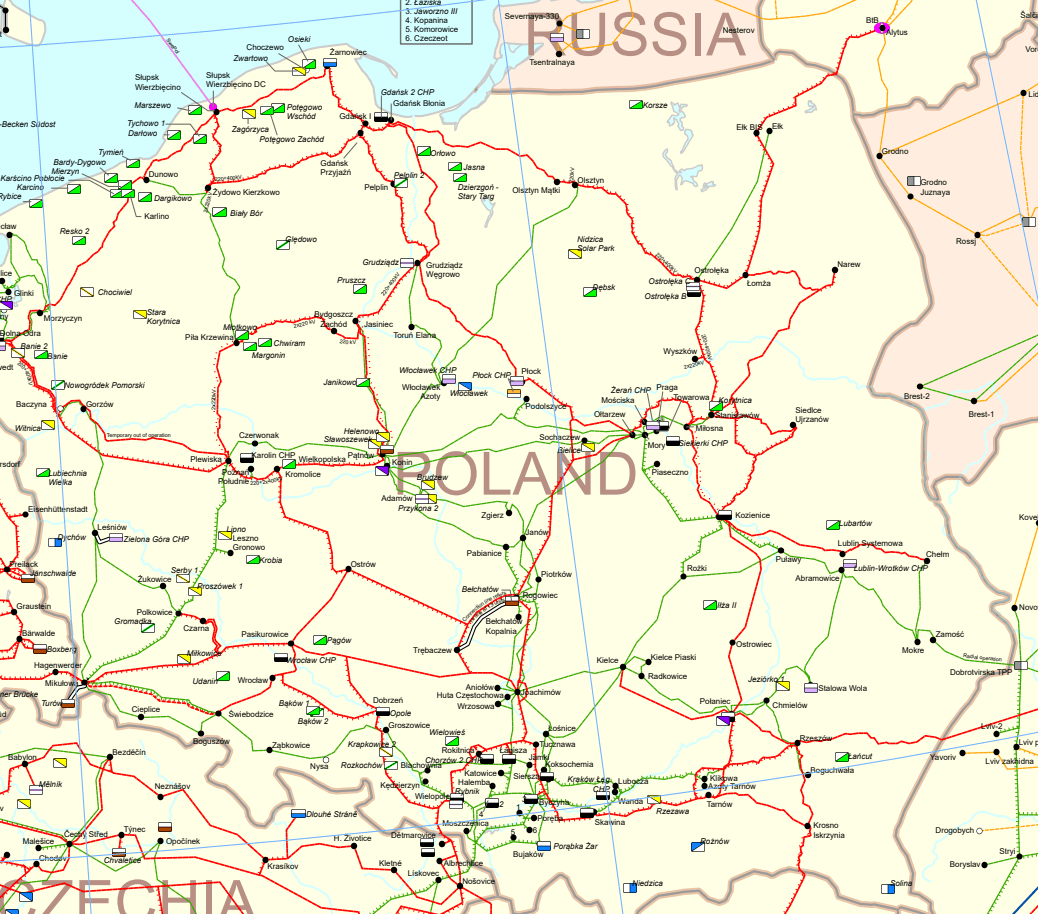
Day-ahead and intraday capacity on Poland's AC borders with Germany, Czechia, and Slovakia, and DC links with Sweden and Lithuania, is implicitly allocated through EU market coupling.
Ukraine interconnectors use explicit auctions, including JAO-coordinated day-ahead auctions for Rzeszów–Chmielnicka and PSE single-sided explicit tenders for Zamość–Dobrotwór.
Poland offers limited forward capacity on its borders due to system inflexibility and growing generation adequacy constraints, with the TSO retaining significant discretion over available capacity.
Poland Power Market Exchange(s)
Poland operates under a multi-NEMO arrangement involving three exchanges: TGE (Polish Power Exchange, owned by the Warsaw Stock Exchange), EPEX SPOT, and Nord Pool.
All three exchanges facilitate day-ahead and intraday spot market trading, fully integrated into the European day-ahead and intraday market coupling (SDAC).
TGE operates a forward market structured as an Organised Trading Facility (OTF) under MiFID II, using physical forward products. This allows a broader range of accepted collateral via the IRGiT clearing house, but does not net countertrades.
Around 130 TWh were traded on TGE's electricity market. EPEX SPOT traded around 2.4 TWh day-ahead and under 1.3 TWh intraday for Poland.
TGE admission is a two-step process: the exchange application, followed by onboarding with the Warsaw Commodity Clearing House (IRGiT), either as a member or via an existing clearing member.
Companies may also trade via a brokerage house instead of direct membership.


5 Market Entry Steps for Poland Power Market
- 01Obtain an OEE licence from URE.
- 02Sign the Transmission Service Agreement with PSE, submit BRP registration and provide financial collateral.
- 03Complete IT qualification and connect to WIRE or the designated market operator.
- 04Register for explicit capacity booking where applicable.
- 05Apply to TGE, EPEX SPOT or Nord Pool power exchanges.
- Post-Market Entry Reporting Obligations.
CorreggioNET, Poland Power Market Access Report
Market Access Reports: CorreggioNET offers Pre-Market Entry Reports (PMER) as part of the PMER Library, providing firms with an A-to-Z guide for market entry.
CorreggioNET Alert Service: Helps you never miss a reporting obligation. Note that Poland has multiple power market reporting obligations, combined with high regulatory volatility - the Energy Law Act is amended several times per year, often with little notice.
CorreggioNET Hotline: For your time-sensitive queries, the Regulatory Hotline Service provides direct support through an online interaction with a qualified regulatory specialist.
Consulting Solutions: For those firms which require additional assistance, Correggio Consulting is on hand to assist with all your licensing needs:
- Obtaining an OEE licence in Poland;
- BRP Registration with PSE;
- TGE Power Exchange registration;
- Onboarding with IRGiT clearing;
- Corporate structuring;
- EFET contract negotiation;
- Yearly compliance audits.

Market Info
Stay Compliant After Market Entry
Entering a new market is only the beginning.
Once trading activity starts, the real challenge is staying compliant with ongoing regulatory updates and reporting obligations. CorreggioNET supports this post-market entry stage through its regulatory platform and monitoring services.
See platform services