
Fast Facts
| Registration lead time | Tacit approval if DGEG does not comment within 30 days of submission |
| Trading licence | Registration as a comercializador with DGEG required |
| Local entity | Not mandatory for market participation |
| Minimum guarantee | EUR 100,000 minimum (imbalances) |
| Renewables-led market | 22.8 GW installed capacity, including 18.4 GW renewable, with renewables supplying over 70% of consumption |
| Import balance | Record net import balance of approximately 10 TWh from Spain |
Portugal Power Market Fundamentals
Portugal's power supply market is liberalised and supplied by comercializadores. The last regulated household tariffs ended on 31 December 2025.
MIBEL, the joint Portugal-Spain electricity market launched in 2007, meaning that Portuguese and Spanish power trade as a single coupled market.
OMIE runs the day-ahead market, where most electricity is traded for the next day, and the intraday market, where positions are adjusted closer to real time.
OMIP runs the forward market for longer-term contracts, cleared by OMIClear, out to ten years.
Consumption reached over 52 TWh and is growing. NECP 2030 targets 96% renewable electricity by 2030, on a path to carbon neutrality.
When Is a Licence Required in Portugal's Power Market?
ERSE is Portugal's energy market regulator, covering regulated revenues, third-party access tariffs and market supervision.
Commercializer Registration: traders must register with the Ministry DGEG in writing before trading begins.
DGEG is the licensing and administrative body that grants the commercialisation registration.
Wholesale trading and supply activities are covered under the single comercializador licence.
Tacit Approval: if DGEG does not respond within 30 days, the registration is automatically approved.
Foreign traders can register without setting up a company in Portugal.
Before network access, traders need an agent code, CRIA from ERSE, REMIT registration with ACER and an EIC identifier from REN.


What Are Portugal's Power Market Licence Requirements for EU and Non-EU Entities?
General rule: Portugal has no automatic mutual-recognition system - DGEG does not register foreign traders automatically based on their home-country licence (even if from an EU Member State). All entrants go through the standard Comercializador registration process, regardless of where they're already licensed.
Foreign (including non-EU) traders: Foreign traders can register as a Comercializador without needing to establish a company in Portugal, as the general starting position. Applicants headquartered abroad must submit their company statutes as part of the application.
However, DGEG reserves the right to require establishment of a Portuguese branch (and therefore a local address) as a condition of registration. This is not automatically required, but it is at DGEG's discretion.
Language requirement: The application must be submitted in Portuguese, or in another language accompanied by an official translation in Portuguese.
Balancing in the Portugal Power Market
REN GGS, Portugal's power TSO and Global System Manager, runs balancing and ancillary services; participants need prior authorisation and certification.
Every market participant and grid access point must have a designated Balance Responsible Party, whose nominations must be balanced.
The system uses four reserve types, from primary regulation through to replacement reserves.
For mFRR, Portugal joined the European MARI platform in November 2024, with imbalance settlement following the ACER harmonised method.
GIG, the Integrated Guarantees Manager, handles imbalance guarantees, with a minimum of EUR 100,000 for imbalances.


Transmission Capacity in the Portugal Power Market
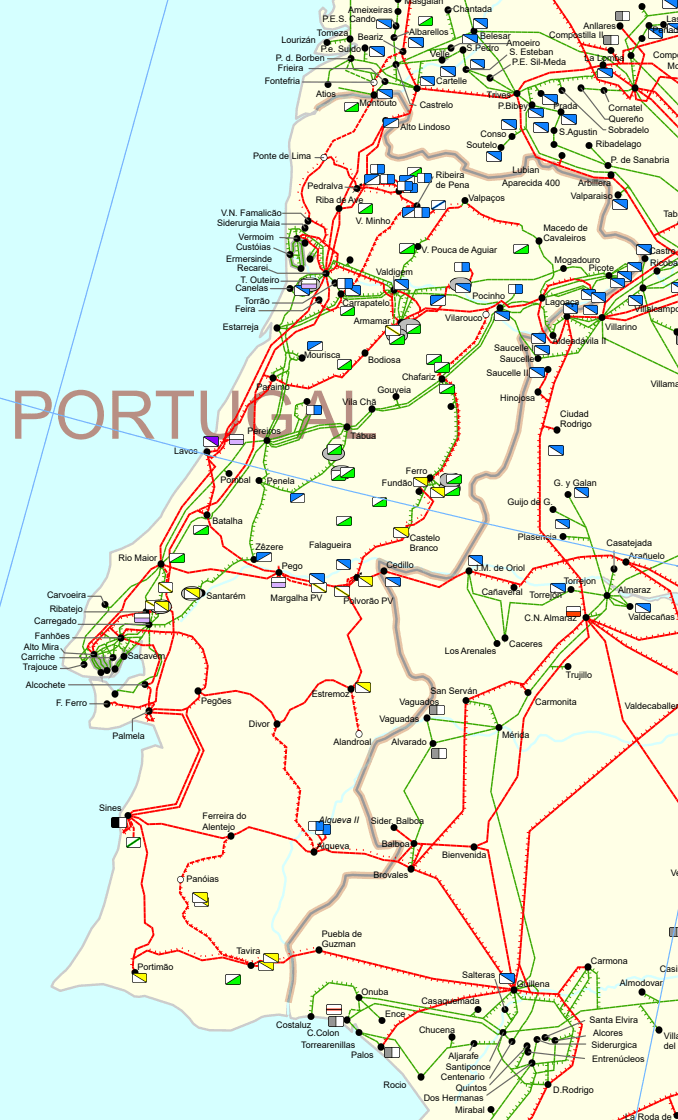
Portugal's transmission grid connects to Spain through five cross-border corridors with nine 220/400 kV circuits.
Cross-border capacity is allocated through Financial Transmission Rights auctioned quarterly in explicit auctions run by JAO.
Market Coupling and Splitting: prices align when the link is uncongested and split when it is congested, with congestion revenue shared equally between Portugal and Spain.
Portugal is a net electricity importer, with a net annual import of approximately 10 TWh.
Portugal Power Market Exchange(s)
OMIE runs the Iberian day-ahead and intraday markets, coupled Europe-wide via SDAC, with quarter-hour products since March 2025.
OMIP manages MIBEL derivatives on the Trayport platform, cleared by OMIClear, with maturities up to ten years.
OMIE admission requires commercializer status and an EIC code, registration as a market agent with REN, OMIE registration and REMIT reporting setup. OMIE acts as a Registered Reporting Mechanism.
OMIP membership is available for Trading Members, dealer or broker, and Clearing Members, subject to admission and annual fees.
About 279 TWh traded on spot markets (up 5.7%), and about 9 TWh through OMIP (up 31%).


5 Market Entry Steps for Portugal Power Market
- 01Register as Commercializer with DGEG.
- 02Obtain the three system codes: CRIA, ACER/REMIT and EIC.
- 03Complete REN onboarding through the adhesion contract.
- 04Register with OMIE and/or OMIP.
- 05Set up guarantees and reporting through GIG, OMIE and OMIP.
- Post-Market Entry Reporting Obligations.
CorreggioNET, Portugal Power Market Access Report
Market Access Reports: CorreggioNET offers Pre-Market Entry Reports (PMER) as part of the PMER Library, providing firms with an A-to-Z guide for market entry.
CorreggioNET Alert Service: Helps you never miss a reporting obligation. Note that Portugal has multiple power market reporting obligations, with a complex and evolving regulatory landscape. The Alert Service ensures you never miss a deadline.
CorreggioNET Hotline: For your time-sensitive queries, the Regulatory Hotline Service provides direct support through an online interaction with a qualified regulatory specialist.
Consulting Solutions: For those firms which require additional assistance, Correggio Consulting is on hand to assist with all your licensing needs:
- Market entry & registration in Portugal;
- DGEG registration & CRIA/ACER/EIC code setup;
- REN onboarding; and BRP registration
- OMIE & OMIP exchange onboarding;
- Corporate structuring;
- EFET contract negotiation;
- Yearly compliance audits.

Market Info
Stay Compliant After Market Entry
Entering a new market is only the beginning.
Once trading activity starts, the real challenge is staying compliant with ongoing regulatory updates and reporting obligations. CorreggioNET supports this post-market entry stage through its regulatory platform and monitoring services.
See platform services