
Fast Facts
| Supply Authorisation Lead Time | DGEC has 3 months to decide; submit at least 3 months ahead, 5 advised |
| Minimum Financial Resources | No statutory minimum; financial and technical capability must be demonstrated |
| Trading Licence | Required for any company buying or selling gas in France, including at the PEG |
| Licence Cost | Free of charge; no statutory fees |
| Authorisation Duration | Permanent, but can be withdrawn after 2 years of non-use or inactivity |
| Storage and LNG Infrastructure | 4 ground-based LNG terminals, 1 FSRU and 16 underground storage sites |
France Gas Market Fundamentals
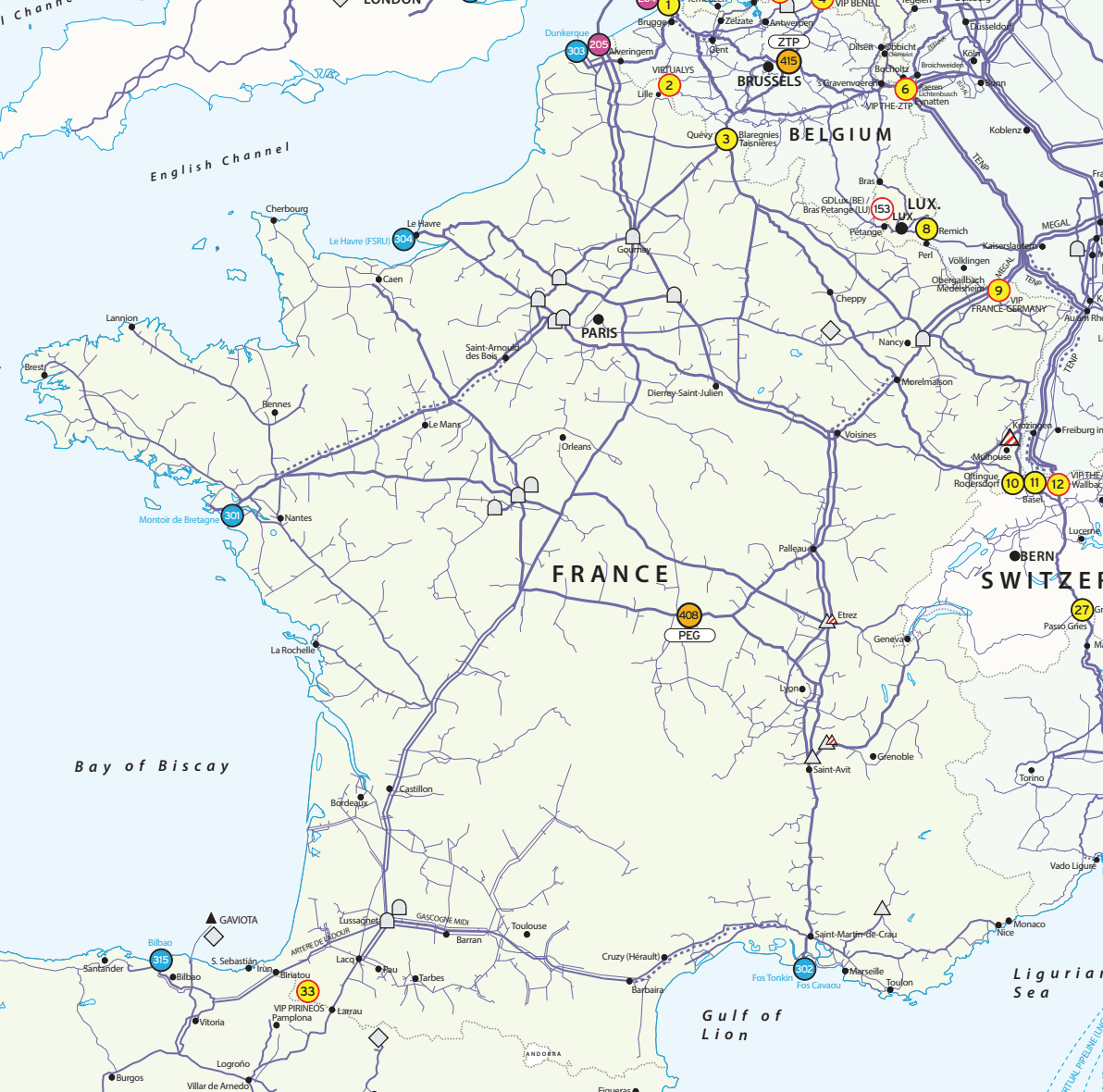
France operates a liberalised single-zone gas market. PEG Nord and PEG Sud merged into the Trading Region France (TRF) in November 2018, with PEG acting as the virtual exchange point and pricing reference for physical and financial transactions.
Trading can occur OTC or through EEX. France covers all gas needs through imports, while gas accounts for a lower share of primary energy supply than in several neighbouring markets due to the nuclear-heavy power mix.
Consumption has declined to around 360 TWh, down significantly since 2021. Renewable gas is expanding, with over 750 biomethane injection points and around 14 TWh of production capacity.
When Is a Licence Required in France's Gas Market?
DGEC - Direction générale de l’énergie et du climat (Government department) issues the gas supply authorisation. The authorisation is required for any company buying or selling gas in France, including at the PEG.
CRE - Commission de régulation de l’énergie (Independent authority) regulates infrastructure access, sets transmission, distribution and storage tariffs, oversees wholesale market conduct and enforces REMIT through its CoRDiS sanctions committee.
The DGEC review period is three months from submission of the dossier. If CRE is consulted, the process can take up to two additional months. The Ministry publishes a list of authorised suppliers, typically updated annually.
What Are France's Gas Market Licence Requirements for EU and Non-EU Entities?
From 13 March 2024, all suppliers must have human and material resources in an EU Member State, an EEA state, or a state party to an agreement of equivalent effect or an energy-supply agreement with France.
France has a mutual recognition agreement with Switzerland (Decree No. 2009-1078). Other non-EU applicants follow the same DGEC dossier process, with equivalent accounting or credit-rating documentation where French equivalents don't exist.
Both EU and non-EU traders must:
Obtain DGEC supply authorisation (application in French);
Obtain an EIC code via ENTSO-G or NaTran;
Sign a transmission contract with NaTran and/or Teréga, via Sign@ir;
Post a guarantee: lesser of €100,000 or €20,000 for own industrial supply via the PEG. Guarantees above €100,000 need an EU-headquartered guarantor;
Provide tax and URSSAF good-standing certificates.
Balancing in the France Gas Market
NaTran and Teréga jointly operate the TRF single balancing zone, with one gas price for the French market. Shippers have a daily balancing obligation and receive hourly imbalance updates.
Imbalance prices are set relative to the EEX-calculated Average PEG Price. Optional neutral-pricing services include ALIZES for NaTran and SET for Teréga.


Transmission Capacity in the France Gas Market
France has six terrestrial interconnection points with neighbouring countries, with capacity of around 2,300 GWh/day for imports and around 900 GWh/day for exports.
Capacity booking is carried out through PRISMA for applicable interconnection points, while shipper operations and contract management are handled through NaTran's INGRID platform or Teréga's IRIS and Teréga Portal.
France Gas Market Exchange(s)
Trading at PEG occurs OTC or on EEX.
PEG is the pricing reference for the TRF zone and is used for physical day-ahead and balancing transactions as well as financial EEX and Powernext futures.
TRF capacity reservation requires at least seven working days' notice. The access tariff includes an annual subscription of EUR 6,000 plus EUR 0.01/MWh traded, whether access is through NaTran or Teréga.
5 Market Entry Steps for France Gas Market
- 01Submit the DGEC supply-authorisation dossier at least 3 months ahead, with 5 months advised.
- 02Await the DGEC decision, allowing 3 months plus up to 2 months if CRE is consulted.
- 03Get an EIC code, sign the NaTran or Teréga transmission contract.
- 04Register for capacity booking and PEG access through INGRID or the Teréga Portal.
- 05Set up balancing arrangements and post guarantees.
- Post-Market Entry Reporting Obligations.
CorreggioNET, France Gas Market Access Report
Market Access Reports: CorreggioNET offers Pre-Market Entry Reports (PMER) as part of the PMER Library, providing firms with an A-to-Z guide for market entry.
CorreggioNET Alert Service: helps you never miss a reporting obligation. Note that France has multiple gas market reporting obligations across the DGEC, CRE, NaTran and Teréga. The Alert Service ensures you never miss a deadline.
CorreggioNET Hotline: For your time-sensitive queries, the Regulatory Hotline Service provides direct support through an online interaction with a qualified regulatory specialist.
Consulting Solutions: For those firms which require additional assistance, Correggio Consulting is on hand to assist with all your licensing needs:
- Market entry & registration in France;
- DGEC supply authorisation support;
- NaTran / Terega onboarding;
- EIC code registration;
- Transmission and PEG access contracts;
- Corporate structuring;
- EFET contract negotiation;
- Yearly compliance audits.

Market Info
Stay Compliant After Market Entry
Entering a new market is only the beginning.
Once trading activity starts, the real challenge is staying compliant with ongoing regulatory updates and reporting obligations. CorreggioNET supports this post-market entry stage through its regulatory platform and monitoring services.
See platform services