
Fast Facts
| Trading Licence | No licence for pure wholesale trading; required only for resale to end-consumers |
| Admission Timeline | Supply-licence application at least 2 months before trading, 4 recommended |
| Minimum Financial Resources | No statutory minimum; RTE requires a BRP bank guarantee |
| Exchange Fees | EEX Full Membership EUR 37k/year, or EUR 22k/year if power-only |
| Bidding Zone | Single bidding zone with EPEX Spot as the exchange |
| Export Position | Net exporter, around 90 TWh |
France Power Market Fundamentals
France has a largely liberalised power market, although EDF's position limits generation and supply competition. Day-ahead and forward liquidity is the second-highest in Europe after Germany/Luxembourg, while intraday liquidity being medium.
The market is a single bidding zone. RTE is the TSO and Enedis serves around 95% of the distribution grid, with the remaining 5% served by local utilities.
Nuclear generation accounts for around 65% of the mix, rising to about 70-75% including EDF hydro and thermal output. France exported around 90 TWh, up from the 50-55 TWh range in prior years.
When Is a Licence Required in France's Power Market?
CRE is France's independent energy regulator. It sets network tariffs, oversees the wholesale market, resolves disputes through CoRDiS, enforces REMIT, co-designs the capacity mechanism with RTE and certifies network operators.
DGEC issues supply and administrative licences. Pure wholesale trading does not require a licence; a licence is required for entities reselling electricity to end-consumers, or for TSOs and DSOs to cover technological losses.
REMIT registration with CRE is required for market participants established or resident in France unless they are already REMIT-registered in another EU or EEA state. Wholesale traders must use a BRP, submit import/export contract information to RTE and respond to CRE inquiries.
What Are France's Power Market Licence Requirements for EU and Non-EU Entities?
No local entity is required for pure wholesale trading; only suppliers need to be established in the EU or under an international agreement.
EU traders do not need a licence for wholesale trading. CRE REMIT registration is waived if the trader is already registered in another EU or EEA member state.
Non-EU traders follow the same access route as any other trader: RTE contracts (BRP/CART), REMIT/CRE registration, and EPEX Spot/ECC access.
Both EU and non-EU BRPs need a bank guarantee from a credit institution rated at least BBB+ (S&P/Fitch) or Baa1 (Moody's), domiciled in the EU, Switzerland or Norway. The guarantor cannot be the BRP itself or an affiliate.
Balancing in the France Power Market
Balance Responsible Parties, or Responsables d'Equilibre, are accredited by RTE and are responsible for keeping supply and demand balanced every 15 minutes. More than 270 BRPs are accredited.
Since 1 January 2025, imbalances are measured every 15 minutes. Becoming a BRP requires RTE contracting, an EIC code, a bank guarantee and financial submissions, although companies can appoint a third party BRP.
Transmission Capacity in the France Power Market
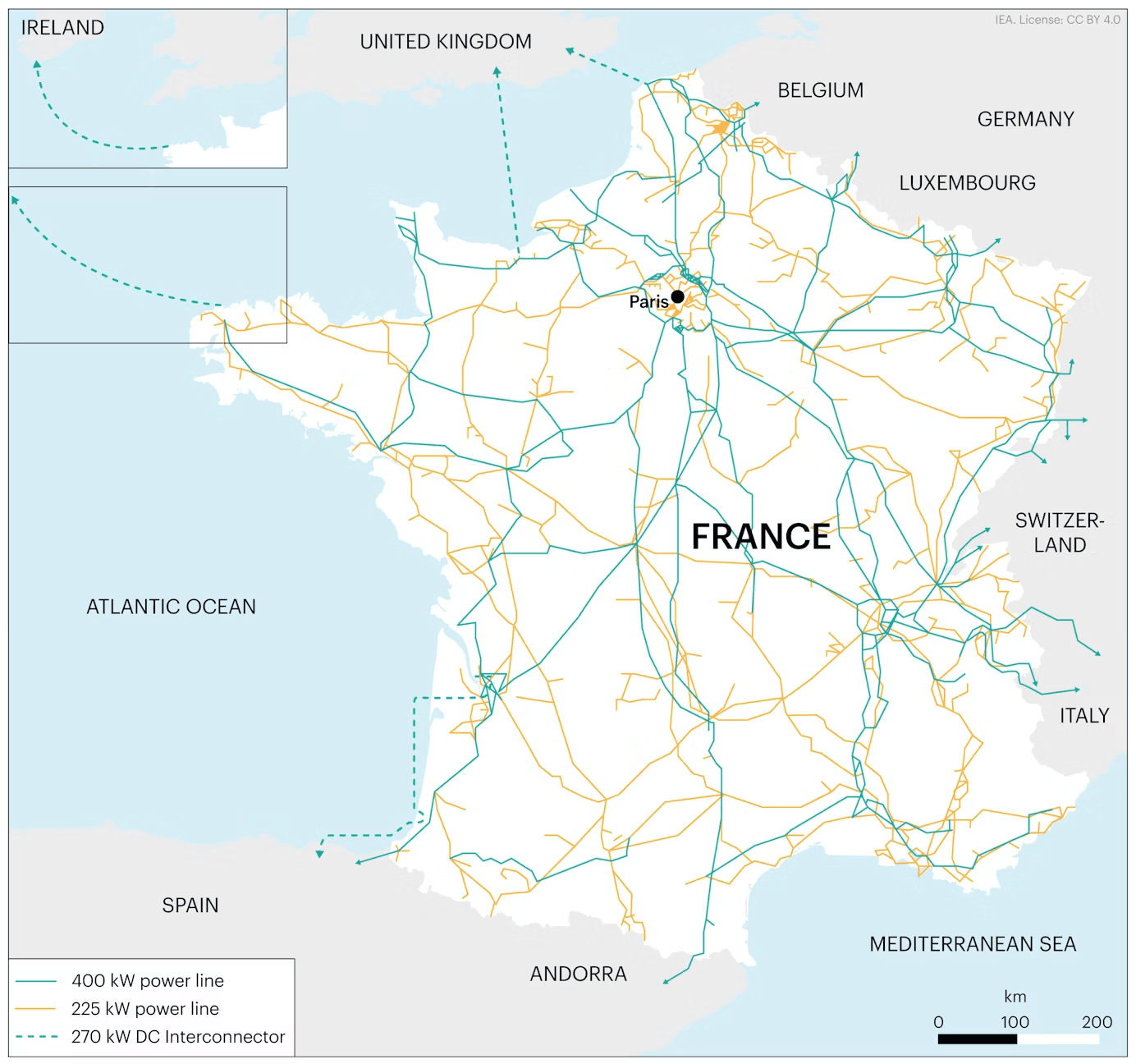
RTE is connected to six neighbouring grids plus the UK through 65 cross-border interconnections. Ireland is expected to join as a seventh link through the 700 MW Celtic Interconnector.
JAO coordinates long-term auctions at the Spain, Italy, Germany and Belgium borders. Day-ahead and intraday markets are coupled at every border except Switzerland, and OCAPPI is used for nominations with all neighbours except the UK.
France Power Market Exchange(s)
EPEX Spot is France's single power exchange. Day-ahead trading moved to 15-minute granularity, while intraday trading uses three daily auctions and continuous trading.
Trading on own account requires RTE contracts, EPEX Spot trader certification, ECC clearing membership, IT connectivity and an account with an ECC-approved clearing bank.
EEX futures are offered as Base and Peak products across weekly, monthly, quarterly and yearly maturities.
5 Market Entry Steps for France Power Market
- 01Register with CRE/REMIT and obtain an EIC code.
- 02Sign CART and connection agreements with RTE.
- 03Become a BRP and provide the required bank guarantee.
- 04Certify with EPEX Spot and become an ECC member.
- 05If reselling to end-consumers, apply for the DGEC supply licence.
- Post-Market Entry Reporting Obligations.
CorreggioNET, France Power Market Access Report
Market Access Reports: CorreggioNET offers Pre-Market Entry Reports (PMER) as part of the PMER Library, providing firms with an A-to-Z guide for market entry.
CorreggioNET Alert Service: Helps you never miss a reporting obligation. Note that France has multiple power market reporting obligations, across DGEC, CRE, RTE, and EEX/EPEX/EC. The Alert Service ensures you never miss a deadline.
CorreggioNET Hotline: For your time-sensitive queries, the Regulatory Hotline Service provides direct support through an online interaction with a qualified regulatory specialist.
Consulting Solutions: For those firms which require additional assistance, Correggio Consulting is on hand to assist with all your licensing needs:
- Market entry & registration in France;
- RTE BRP / CART onboarding;
- Cross-border capacity (JAO);
- EPEX Spot / ECC exchange onboarding;
- Corporate structuring;
- EFET contract negotiation;
- Yearly compliance audits.

Market Info
Stay Compliant After Market Entry
Entering a new market is only the beginning.
Once trading activity starts, the real challenge is staying compliant with ongoing regulatory updates and reporting obligations. CorreggioNET supports this post-market entry stage through its regulatory platform and monitoring services.
See platform services