
Fast Facts
| THE Onboarding | THE registration can take up to 6 months |
| Minimum Financial Resources | No statutory minimum; financial securities required for TSO capacity and THE balancing |
| Trading Licence | None required for wholesale trading or supply |
| Required Codes | ACER, DVGW code and GLC (GS1) |
| Market Area Manager | Trading Hub Europe (THE), single VTP |
| Imports | Over 850 TWh; approx.: Norway 48%, via Netherlands 25%, via Belgium 18% |
Germany Gas Market Fundamentals
Germany's gas market is fully liberalised. Unlike most European markets, the transmission system is operated by multiple privately organised TSOs rather than a single or dual TSO model.
Trading Hub Europe (THE) has been the single Virtual Trading Point and Market Area Manager since October 2021, following the merger of GASPOOL and NetConnect Germany. THE is the largest active gas hub in Continental Europe by traded volume.
Wholesale gas at THE is traded mainly OTC, with access directly via EEX or ICE Endex or through brokers.
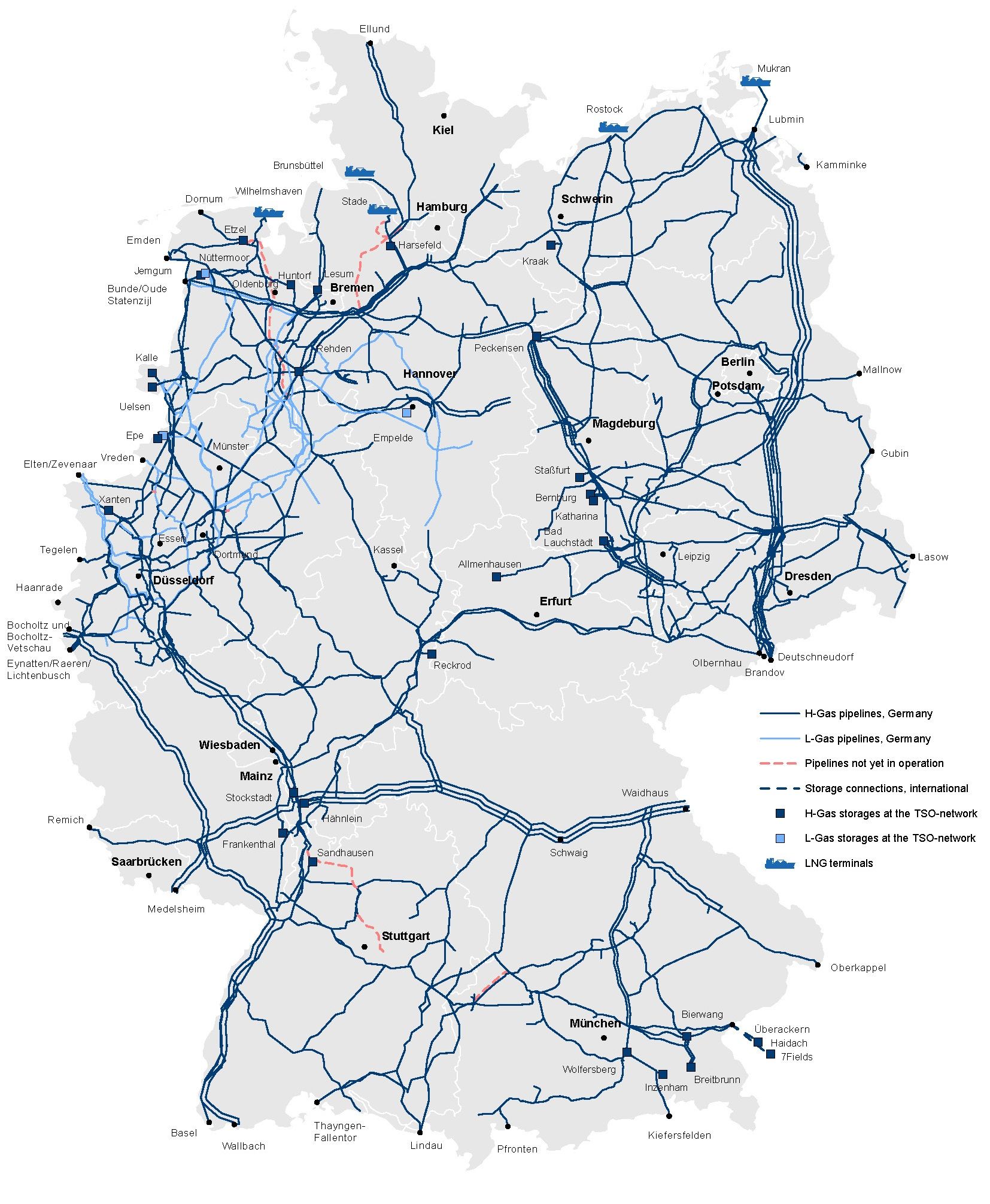
Germany imported over 850 TWh, down from a record above 1,400 TWh, with LNG now contributing around 8% of the total, following the loss of Russian pipeline supply, which covered roughly half of annual consumption, prompting new LNG terminals at Wilhelmshaven, Brunsbüttel, Lubmin and Mukran.
Germany targets a 65% emissions cut from 1990 levels and GHG neutrality by 2045, supported by a newly approved Hydrogen Core Network (Wasserstoff-Kernnetz).
When Is a Licence Required in Germany's Gas Market?
There is no licence or local-presence requirement to start gas trading or supply in Germany. Wholesale trading and supply are competitive activities and are only lightly regulated.
The real market-entry gate is a valid THE balancing group contract. A company must hold a Bilanzkreisvertrag to operate in the THE market area, either as a Balancing Group Manager or under an existing BGM's balancing group.
To book transport capacity, shippers enter network access agreements with the relevant TSO or TSOs under the standardised KoV framework.
BNetzA is the federal regulator for electricity and gas under the Energy Industry Act.
What Are Germany's Gas Market Licence Requirements for EU and Non-EU Entities?
Companies from the EU, UK, Switzerland or any other jurisdiction may register with THE (Trading Hub Europe); no local German presence is required.
Before registering with THE, companies must obtain three codes: an ACER code under REMIT, a DVGW code for the relevant German gas market function (applied for online, at a cost), and a Global Location Code (GLC) from GS1 Germany.
Once these codes are in hand, pre-registration is completed through THE's Customer Platform by submitting company details, VAT number, the ACER and DVGW codes, and bank details, followed by KYC checks.
Balancing in the Germany Gas Market
Trading Hub Europe (THE) is the Market Area Manager, operating the VTP and managing balancing groups. THE procures balancing gas via a merit order list, trading on EEX, TTF and ICE.
Germany's balancing regime follows the EU Network Code on Gas Balancing and is implemented through GaBi Gas 2.0, approved by BNetzA.
The regime is organised around balancing groups managed by registered BGMs. THE uses products including Long-Term Options, Short-Term Balancing, Short-Call Balancing, Flexibility Services and a Load Reduction product.
Imbalances between entry and exit quantities are monetised at the end of each gas day and invoiced monthly through neutrality accounts.
Transmission Capacity in the Germany Gas Market
German TSOs offer transmission under an entry/exit model; 15 of them also operate gas storage facilities. Gas enters and leaves the network at connection points or is traded at the THE VTP.
Capacity products are standardised under KASPAR, and primary and secondary capacity are booked through PRISMA. Products range from yearly to within-day and booked capacity is assigned to a THE balancing group.
Germany Gas Market Exchange(s)
THE is the single Virtual Trading Point for the German market area and the largest active gas hub in Continental Europe by traded volume.
Wholesale gas is traded mainly OTC, through EEX or ICE Endex or through brokers.
EEX is the principal exchange venue for German gas spot and futures products.
THE offers continuous 24/7 trading for within-day (three-hour lead time), day-ahead and weekend contracts.
5 Market Entry Steps for Germany Gas Market
- 01Obtain the required ACER, DVGW and GLC (GS1) codes.
- 02Enter network access agreements with the relevant TSO or TSOs under the KoV framework.
- 03Pre-register with THE and complete KYC.
- 04Conclude the balancing group contract and register as a Balancing Group Manager.
- 05Begin trading at the THE VTP or register with EEX or ICE Endex.
- Post-Market Entry Reporting Obligations.
CorreggioNET, Germany Gas Market Access Report
Market Access Reports: CorreggioNET offers Pre-Market Entry Reports (PMER) as part of the PMER Library, providing firms with an A-to-Z guide for market entry.
CorreggioNET Alert Service: Helps you never miss a reporting obligation. Note that Germany has several gas market reporting obligations across BNetzA, THE the Market Transparency Office and the tax authorities. The Alert Service ensures you never miss a deadline.
CorreggioNET Hotline: For your time-sensitive queries, the Regulatory Hotline Service provides direct support through an online interaction with a qualified regulatory specialist.
Consulting Solutions: For those firms which require additional assistance, Correggio Consulting is on hand to assist with all your licensing needs:
- Market entry & registration in Germany;
- THE registration (balancing group contract);
- TSO network access & capacity booking;
- Corporate structuring;
- Exchange onboarding;
- EFET contract negotiation;
- Yearly compliance audits.

Market Info
Stay Compliant After Market Entry
Entering a new market is only the beginning.
Once trading activity starts, the real challenge is staying compliant with ongoing regulatory updates and reporting obligations. CorreggioNET supports this post-market entry stage through its regulatory platform and monitoring services.
See platform services