
Fast Facts
| Trading Licence | None required for wholesale electricity trading |
| BRP Onboarding | Standard Balancing Agreement with the relevant TSO |
| Minimum Financial Resources | No statutory minimum; collateral set by TSO credit assessment |
| Required Registrations | MaStR, BDEW Code and ACER |
| TSOs | 50Hertz, Amprion, TenneT and TransnetBW |
| Renewable Generation | Installed capacity around 263 GW; renewables approx. 63% of net generation |
Germany Power Market Fundamentals
Germany's power market is fully liberalised and one of the most liquid and sophisticated in Europe. Generation and supply are liberalised, while transmission and distribution remain regulated under BNetzA oversight.
The transmission grid is operated by four TSOs: 50Hertz, Amprion, TransnetBW and TenneT. Germany and Luxembourg form a single bidding zone with one wholesale price.
Wholesale electricity is traded OTC and on EPEX SPOT, EEX, Nord Pool and EXAA. Renewables account for approx. 63% of net generation, with Germany targeting an 80% renewable share by 2030.
Germany imports around 67 TWh, mainly from France and Denmark, and exports even more, reflecting its central role in EU power flows.
Nuclear generation has been phased out entirely, and a full coal phase-out is planned by the end of 2038.
When Is a Licence Required in Germany's Power Market?
No specific licence is required for wholesale electricity trading in Germany. The real gate for physical trading is the Standard Balancing Agreement with the relevant TSO scheduling area.
Signing the Bilanzkreisvertrag Strom makes the company a Balance Responsible Party responsible for quarter-hourly balancing. The BNetzA-approved agreement is identical across all four TSOs, with the latest version in force since 1 October 2024.
Participants must register in the Marktstammdatenregister (MaStR), obtain a BDEW Code and hold an ACER code.
Participation is open to non-EU companies such as Swiss or UK entities subject to prequalification.
What Are Germany's Power Market Licence Requirements for EU and Non-EU Entities?
These requirements apply equally to EU and non-EU entities:
Market participants register once in the MaStR (Marktstammdatenregister); no renewal is required. They must also hold a BDEW market-partner identification code, which uniquely identifies the participant and its role and must be renewed annually (fee: €65 fixed plus €17 per allocated code), along with an ACER code under REMIT.
To become a recognised Balance Responsible Party, participants complete a connection test using AS4 messages via EDIFACT, encrypted with a recognised electronic certificate.
Non-EU entities, including companies registered in Switzerland, the UK or elsewhere, may also participate, provided they meet prequalification requirements.
Balancing in the Germany Power Market
Germany's four TSOs jointly manage the balancing market through regelleistung.net. Each BRP is responsible for keeping its balancing group balanced in each 15-minute period.
Imbalances are settled at a single nationwide imbalance price per 15-minute period, applied uniformly across all four TSO areas.
Balancing products include FCR, aFRR and mFRR, aligned under the EU Electricity Balancing Guideline.
Germany participates in European platforms including PICASSO, MARI, TERRE and the FCR Cooperation, with the ALPACA cooperation covering aFRR capacity exchange with neighbouring TSOs.
Transmission Capacity in the Germany Power Market
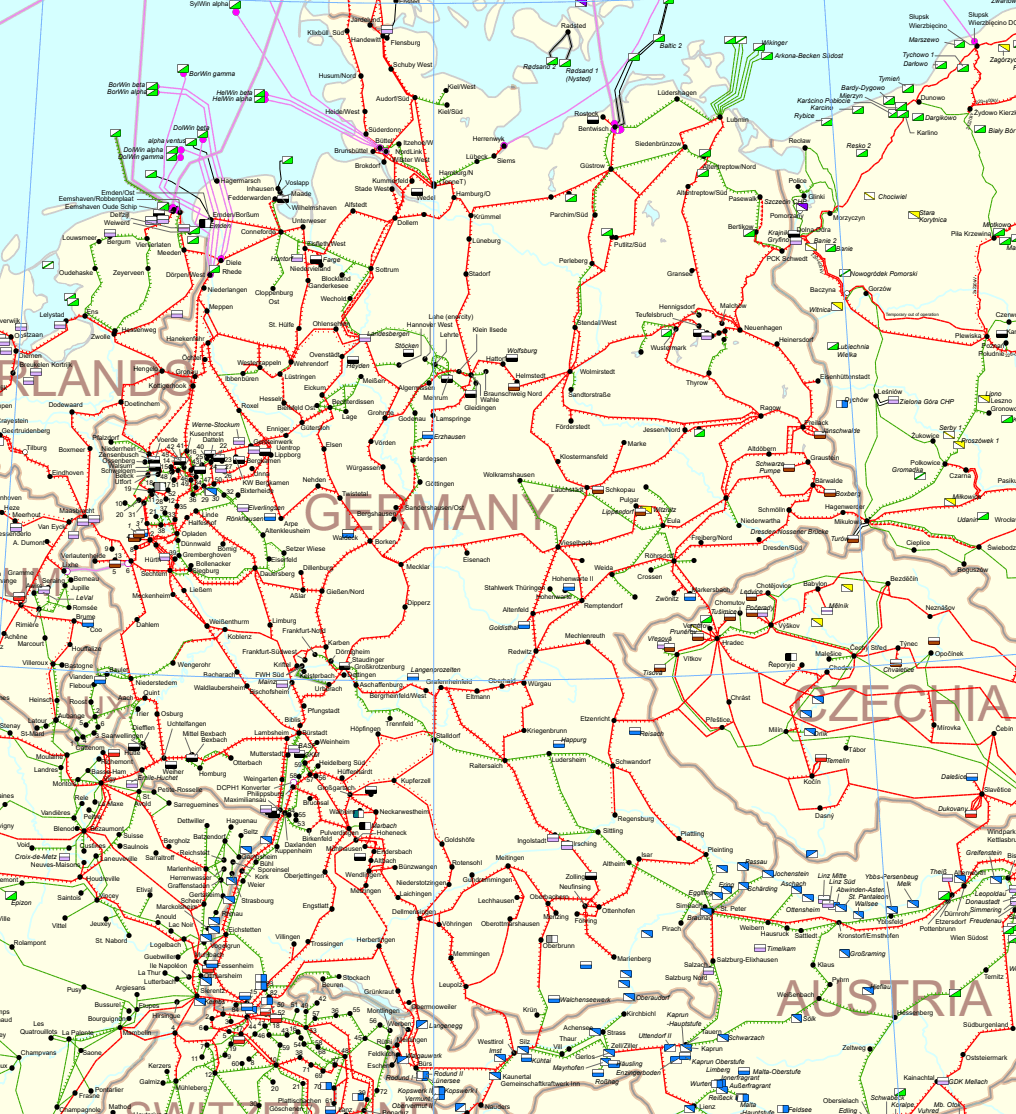
Germany's > 220 kV transmission grid is operated by the TSOs: 50Hertz, Amprion, TenneT and TransnetBW, each managing its own scheduling area under BNetzA and ACER supervision.
Explicit daily, monthly and yearly cross-border capacity is marketed via JAO, while intraday cross-border capacity is allocated implicitly through market coupling.
Trading physical electricity across multiple TSO scheduling areas requires a separate Standard Balancing Agreement with each TSO concerned.
Germany Power Market Exchange(s)
Germany is the pillar of the EU-wide market-coupling system.
EPEX SPOT (Spot): Operates the day-ahead auction (single SDAC price for the German bidding zone, cleared at 12:00 D-1) and the continuous intraday market, with hourly and quarter-hourly products.
Nord Pool & EXAA (Spot): Nord Pool offers German day-ahead and intraday access (with in-house clearing); EXAA operates an early day-ahead auction.
EEX (Futures): Provides long-term futures trading with monthly, quarterly and yearly delivery periods.
A membership agreement with the exchange (financial standing, collateral, VAT registration) and a balancing agreement with the relevant TSO(s) are required; EPEX SPOT additionally requires a clearing bank or an ECC clearing agreement.



5 Market Entry Steps for Germany Power Market
- 01Register in the MaStR and obtain BDEW and ACER codes.
- 02Sign the Standard Balancing Agreement with the relevant TSO.
- 03Complete IT qualification and provide TSO collateral.
- 04Obtain BRP acknowledgement and go live.
- 05Apply for exchange membership and arrange clearing.
- Post-Market Entry Reporting Obligations.
CorreggioNET, Germany Power Market Access Report
Market Access Reports: CorreggioNET offers Pre-Market Entry Reports (PMER) as part of the PMER Library, providing firms with an A-to-Z guide for market entry.
CorreggioNET Alert Service: Helps you never miss a reporting obligation. Note that Germany has multiple power market reporting obligations across BNetzA, the four TSOs, the Market Transparency Office and the tax authorities. The Alert Service ensures you never miss a deadline.
CorreggioNET Hotline: For your time-sensitive queries, the Regulatory Hotline Service provides direct support through an online interaction with a qualified regulatory specialist.
Consulting Solutions: For those firms which require additional assistance, Correggio Consulting is on hand to assist with all your licensing needs:
- Market entry & registration in Germany;
- BRP acknowledgement (Standard Balancing Agreement);
- Power exchange onboarding (EPEX SPOT / EEX / Nord Pool / EXAA);
- Corporate structuring;
- EFET contract negotiation;
- Yearly compliance audits.

Market Info
Stay Compliant After Market Entry
Entering a new market is only the beginning.
Once trading activity starts, the real challenge is staying compliant with ongoing regulatory updates and reporting obligations. CorreggioNET supports this post-market entry stage through its regulatory platform and monitoring services.
See platform services