
Fast Facts
| Licence Types | Limited wholesale-only and full-scale wholesale plus end-customer supply |
| Licence Fee | HUF 4,000,000 full-scale (approx. EUR 11,100) or HUF 2,000,000 limited (approx. EUR 5,600) |
| Annual Supervisory Fee | 0.085% of previous-year net turnover |
| Licence Validity | Indefinite |
| Transit Activity | No transit licence required; registration with FGSZ only |
| Gas Exchange | CEEGEX is Hungary's spot gas exchange and the most liquid trading venue |
Hungary Gas Market Fundamentals
Hungarian natural gas trading operates in a liberalised, EU-aligned market governed by Act XL of 2008 on Natural Gas. MVM Group controls most gas production, infrastructure and supply, while FGSZ Zrt. acts as the national TSO.
Wholesale gas is traded OTC or on CEEGEX, Hungary's organised gas market for spot and forward products. Hungary is also a key Central European gas transit corridor.
MEKH, also referred to as HEPURA, oversees licensing, reporting and market supervision for the gas sector.
When Is a Licence Required in Hungary's Gas Market?
Gas market participants must hold either a limited natural gas trading licence for wholesale-only activity or a full-scale trading licence covering wholesale and end-customer supply.
EU and EEA entities lawfully trading natural gas in their home state can apply directly using their foreign company, without establishing a Hungarian entity. A local delivery agent must be appointed.
The licence fee is HUF 4,000,000 (approx. EUR 11,100) for full-scale licences or HUF 2,000,000 (approx. EUR 5,600) for limited licences under MEKH Decree No. 1/2014.
Gas transit through Hungary does not require a trading licence, but must be registered with FGSZ.

What Are Hungary's Gas Market Licence Requirements for EU and Non-EU Entities?
EU entities with an existing natural gas trading licence in another EU jurisdiction may apply directly using their foreign company, without establishing a local entity. They must appoint a local delivery agent in Hungary to receive documents and certify their right of representation on the licence holder's behalf.
Non-EU and non-EEA entities must first establish an entity within the EU, which may be in Hungary, before applying for a Hungarian gas trading licence. This requirement applies to all entities outside the EU and EEA.
Once EU-established, the same local delivery agent requirement applies.
Balancing in the Hungary Gas Market
FGSZ Zrt. is Hungary's gas TSO and is responsible for transmission system operation, cross-border gas exchanges and system balancing.
Trading licence holders must enter a cooperation agreement and a Network Usage Framework Contract with FGSZ.
Participants provide daily nominations, re-nominations and capacity-related data under the FGSZ Commercial Code.
CEEGEX and OTC trading can be used to manage balancing-related positions, and LinePack Flexibility Services are available as an additional balancing tool.
Transmission Capacity in the Hungary Gas Market
FGSZ manages cross-border transmission capacity at Hungary's entry and exit points. Licence holders must declare expected demand in accordance with the FGSZ Commercial Code.
Trading licence holders with long-term cross-border gas supply contracts must notify HEPURA (MEKH) annually, by 31 August. This applies if the contracts meet or exceed 28% of Hungary's annual domestic gas consumption.
Hungary Gas Market Exchange(s)
Primary Gas Exchange: CEEGEX (Central Eastern European Gas Exchange) is Hungary's primary organised gas market for spot gas trading, operated in Budapest and serving Hungary primarily, but also the Central Eastern European region.
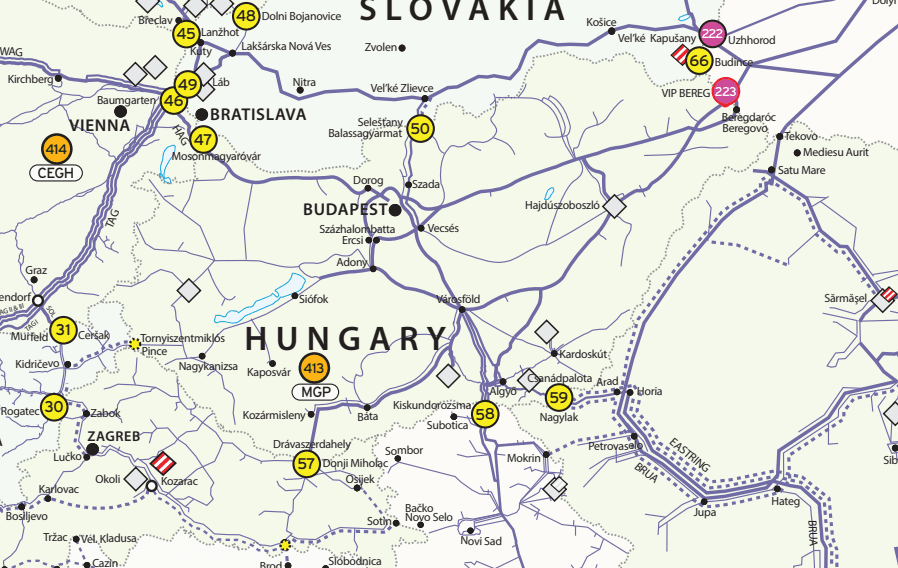
KP Platform: In addition to CEEGEX, traders can access Hungary's Virtual Trading Point / Hungarian Balancing Point (MGP, Magyar Gázkiegyenlítő Pont) via the KP Platform, operated directly by FGSZ. Traders must sign an accession agreement with FGSZ to join. Both CEEGEX and the KP Platform use MGP as the standard delivery point.
Market Rules: CEEGEX operates under its own Market Rules (available in English on the CEEGEX website), which govern membership, trading, and reporting obligations. CEEGEX trades are cleared through KELER.
OTC Trading: In addition to exchange trading, participants may trade bilaterally OTC, subject to REMIT reporting obligations to MEKH and ACER.
5 Market Entry Steps for Hungary Gas Market
- 01Obtain the MEKH licence or apply directly through an eligible EU entity.
- 02Appoint a local delivery agent in Hungary.
- 03Sign cooperation and network-usage agreements with FGSZ.
- 04Register for entry/exit capacity booking with FGSZ.
- 05Apply to CEEGEX gas exchange.
- Post-Market Entry Reporting Obligations.
CorreggioNET, Hungary Gas Market Access Report
Market Access Reports: CorreggioNET offers Pre-Market Entry Reports (PMER) as part of the PMER Library, providing firms with an A-to-Z guide for market entry.
CorreggioNET Alert Service: Helps you never miss a reporting obligation. Note that Hungary has multiple gas market reporting obligations administered through the MEKH electronic reporting platform. The Alert Service ensures you never miss a deadline.
CorreggioNET Hotline: For your time-sensitive queries, the Regulatory Hotline Service provides direct support through an online interaction with a qualified regulatory specialist.
Consulting Solutions: For those firms which require additional assistance, Correggio Consulting is on hand to assist with all your licensing needs:
- Obtaining a gas licence in Hungary;
- Passporting an EU licence in Hungary;
- Local delivery agent appointment & reporting;
- CEEGEX Exchange onboarding;
- KELER clearing onboarding;
- Corporate structuring;
- EFET contract negotiation;
- Yearly compliance audits.

Market Info
Stay Compliant After Market Entry
Entering a new market is only the beginning.
Once trading activity starts, the real challenge is staying compliant with ongoing regulatory updates and reporting obligations. CorreggioNET supports this post-market entry stage through its regulatory platform and monitoring services.
See platform services