
Fast Facts
| Licence Lead Time | 75 days |
| Licence Fee | HUF 6,000,000, approximately EUR 16,700 |
| Licence Validity | Indefinite |
| Annual Supervisory Fee | 0.085% of previous-year turnover |
| Largest Energy Source | Nuclear, around 50%, via Paks NPP |
| Generation Capacity | Around 11,500 MW |
Hungary Power Market Fundamentals
Hungary's electricity trading operates in a fully liberalised, EU-integrated power market dominated by the state-owned MVM Group, which controls approximately 75% of national electricity production.
The market is split between a Universal Service segment for households, served by MVM Next, and a Free Market segment for industrial customers contracted freely.
Hungary is served by HUPX for spot day-ahead and intraday trading and PXE Hungary for financially settled power futures.
HUPX is integrated into European SDAC and SIDC market coupling and joined the ADEX Group alongside Slovenia's BSP and Serbia's SEEPEX, forming the leading power trading hub in Central and Southeastern Europe.
Installed solar PV capacity has reached > 4 GW, supported by household microgeneration exceeding 3 GW.
When Is a Licence Required in Hungary's Power Market?
A full-scale electricity trading licence is mandatory for market participants supplying end-customers, in addition to wholesale activities.
A wholesale-only limited licence is no longer available to new applicants since March 2021; EU/EEA entities that obtained one before that date retain their existing exemptions.
EU and EEA entities lawfully trading electricity in their home state can apply directly using their EU company, without establishing a Hungarian entity.
The MEKH application includes a business plan, organisational chart, auditor opinion, UBO declaration and home-country authorisation statement and certificate. The fee is HUF 6,000,000 (approx. EUR 16,700), with processing taking 75 days from a complete dossier.

What Are Hungary's Power Market Licence Requirements for EU and Non-EU Entities?
EU entities with an existing power trading licence in another EU jurisdiction can apply directly using their foreign company to trade in Hungary, without establishing a local entity. EU applicants must appoint a local delivery agent in Hungary to receive documents on the licence holder's behalf.
Non-EU and non-EEA entities must first establish an entity within the EU, which may be set up in Hungary, in order to obtain a supply or trading licence. This requirement applies to all entities outside the EU and EEA.
Foreign entities applying without a local Hungarian entity must also appoint a local representative, who receives documents and certifies the entity's right of representation on the licence holder's behalf.
Balancing in the Hungary Power Market
MAVIR is Hungary's TSO, manages grid operations and acts as the balancing market operator. Market participants must register as a Balance Responsible Party with MAVIR or join an existing balance group.
The BRP guarantee is HUF 15 million (approx. EUR 41,700) for a one-member balance group and HUF 50 million (approx. EUR 139,000) for a group with multiple members.
Transmission Capacity in the Hungary Power Market
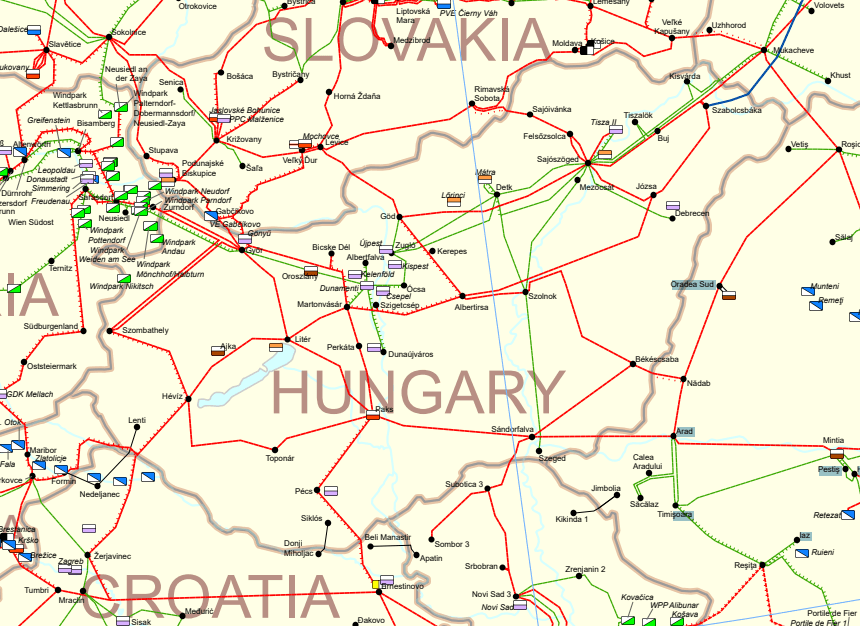
Day-ahead and intraday capacity for EU-connected borders is integrated into European coupling mechanisms. Serbian and Ukrainian borders also mark the EU's external customs boundary, requiring customs declarations after electricity deliveries.
Traders register with MAVIR allocation auctions for yearly, monthly, weekly and daily capacity. Hungary imports around 23 TWh and exports around 12 TWh, making it a net electricity importer.
Cross-border electricity schedules must be nominated to MAVIR prior to delivery, in accordance with MAVIR's Commercial Code.
Hungary Power Market Exchange(s)
Two Exchanges: Hungary operates two power exchanges: HUPX (part of ADEX Group, spot market) and PXE Hungary (part of EEX Group, futures market), both serving the Hungarian electricity sector.
EU Market Coupling Operator: HUPX facilitates the Day-Ahead and Intraday spot markets, which are fully integrated into the European SDAC and SIDC coupling mechanisms.
Clearing: HUPX transactions are cleared by European Commodity Clearing AG (ECC), the clearing house used across all EPEX Spot markets.
PXE Hungary manages only financially-settled power futures, requiring a clearing bank relationship and ECC admission for direct participation.

5 Market Entry Steps for Hungary Power Market
- 01Obtain the MEKH licence or rely on EU passporting.
- 02Register as a Balance Responsible Party with MAVIR.
- 03Provide BRP performance security and select a clearing bank.
- 04Pass the HUPX trader exam.
- 05Apply to HUPX power exchange.
- Post-Market Entry Reporting Obligations.
CorreggioNET, Hungary Power Market Access Report
Market Access Reports: CorreggioNET offers Pre-Market Entry Reports (PMER) as part of the PMER Library, providing firms with an A-to-Z guide for market entry.
CorreggioNET Alert Service: Helps you never miss a reporting obligation. Note that Hungary has multiple power market reporting obligations, administered through the MEKH electronic reporting platform. The Alert Service ensures you never miss a deadline.
CorreggioNET Hotline: For your time-sensitive queries, the Regulatory Hotline Service provides direct support through an online interaction with a qualified regulatory specialist.
Consulting Solutions: For those firms which require additional assistance, Correggio Consulting is on hand to assist with all your licensing needs:
- Obtaining a MEKH licence in Hungary;
- Passporting an EU licence in Hungary;
- BRP Registration with MAVIR;
- HUPX Exchange onboarding;
- Corporate structuring;
- EFET contract negotiation;
- Yearly compliance audits.

Market Info
Stay Compliant After Market Entry
Entering a new market is only the beginning.
Once trading activity starts, the real challenge is staying compliant with ongoing regulatory updates and reporting obligations. CorreggioNET supports this post-market entry stage through its regulatory platform and monitoring services.
See platform services