
Fast Facts
| Trading Licence | No licence required for wholesale trading |
| GME Admission Timeline | 15 calendar days from complete application |
| Minimum Financial Resources | No statutory minimum; financial guarantees required by Terna and GME |
| GME one-off Access Fee | EUR 7,500 |
| GME Annual Fixed Fee | EUR 10,000 |
| Renewables Share | Around 41% of demand |
Italy Power Market Fundamentals
Italy's electricity market is fully liberalised and EU-integrated, operated by GME (Gestore dei Mercati Energetici) and the TSO Terna.
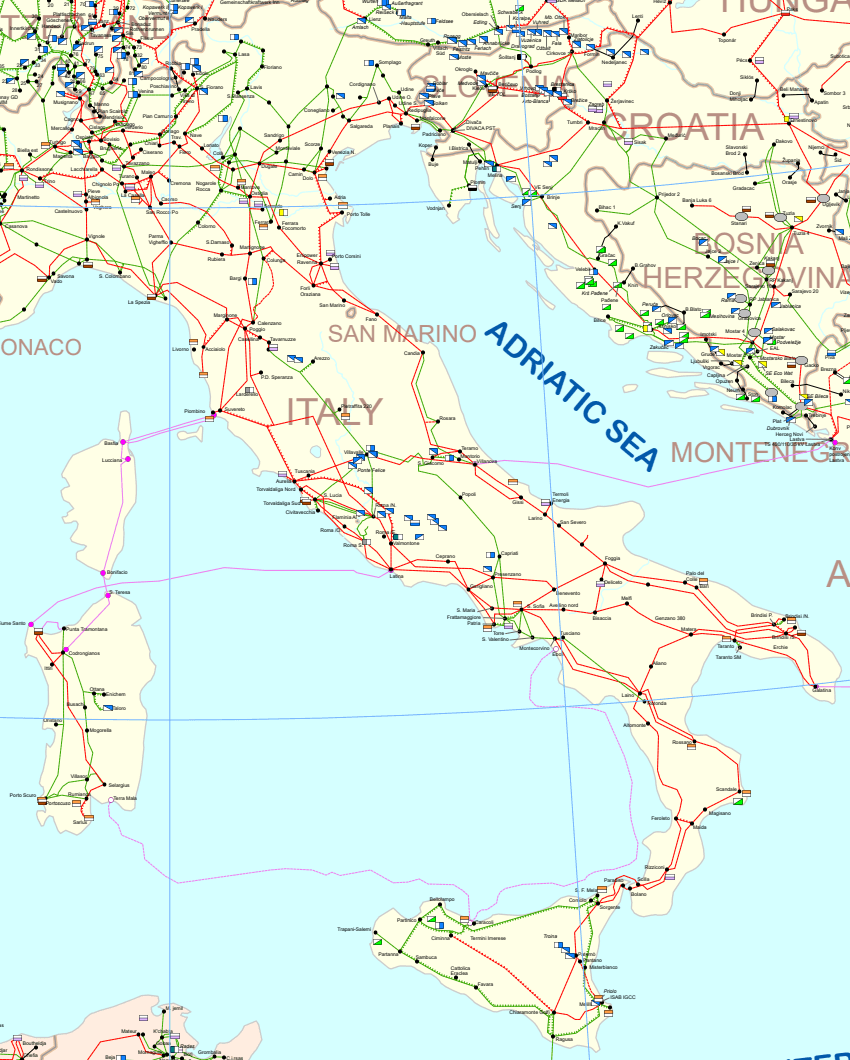
Italy has a single exchange, GME, running day-ahead, intraday and forward markets fully coupled into SDAC and SIDC mechanisms. Internal transmission limits divide Italy into seven internal bidding zones, plus 14 foreign virtual zones.
Italy has long been a net electricity importer. Domestic production meets around 84% of demand, with net imports covering the remainder. Renewables cover a significant share of demand, around 41%.
When Is a Licence Required in Italy's Power Market?
ARERA is Italy's independent energy regulator.
MASE (Ministero dell'Ambiente e della Sicurezza Energetica) sets energy policy, playing a key role in the Italian energy market.
No specific licence is required for wholesale or cross-border electricity trading. Retail supply to final customers requires registration in the MASE list of entities authorised to sell electricity to final customers.
Physical electricity traders must sign the Standard Balancing Agreement, or Contratto di dispacciamento, with the TSO Terna. Participation in GME organised markets also requires admission as a market participant.
Operators executing bilateral electricity contracts should also consider the Energy Accounts Platform, Piattaforma Conti Energia (PCE), managed by GME on behalf of Terna, used to register bilateral contracts and related injection/withdrawal schedules.
Operators must enrol in ARERA's Anagrafica Operatori register and notify relevant changes within 15 days. No local establishment is required for wholesale electricity trading.

What Are Italy's Power Market Licence Requirements for EU and Non-EU Entities?
EU traders need no local licence or passported licence to trade wholesale electricity in Italy, because no wholesale trading licence exists.
Non-EU traders do not need a local Italian presence and follow the same route as other participants: TSO Terna dispatching contract, GME admission and ARERA registration.
ARERA Registration: All traders, EU and non-EU alike, must enrol in ARERA's Anagrafica Operatori register.
Financial Guarantees: Both EU and non-EU traders must meet Terna and GME guarantee requirements: a bank guarantee from a bank rated at least BBB-/Baa3, or a cash deposit.
Balancing in the Italy Power Market
The TSO Terna operates Italy's central dispatching model and procures balancing resources through the Ancillary Services Market, jointly with GME.
Balance Responsible Parties, or Utente del Dispacciamento, answer to Terna for executing schedules.
Until 1 February 2026, the BRP and BSP were the same entity, unlike most EU countries; this changed under the TIDE balancing reform.
The TIDE reform allows renewable generators to participate in ancillary services through aggregated Virtual Power Plants.
Following exits from PICASSO (2024) and TERRE (2024), Terna now procures mFRR, aFRR, FCR and RR only nationally.

Transmission Capacity in the Italy Power Market
Terna manages cross-border transmission capacity, auctioned through JAO and SEE CAO platforms. Borders with France, Austria, Greece and Slovenia are coupled, with yearly and monthly capacity auctions.
Northern-border import capacity is around 8.5 GW; the Montenegro border (600 MW, daily) and Greek border (500 MW) are smaller routes.
Intraday capacity is allocated via XBID on the France, Austria and Slovenia interconnections, and via CRIDAs on Slovenia and Greece.
Switzerland is not yet coupled, with yearly, monthly and daily capacity auctioned on the Swiss border.
Import/export activity requires a BRP contract, virtual import or export units and daily nominations to Terna through DAMAS platform.
Italy Power Market Exchange(s)
GME is Italy's single power exchange and provides a centralised platform across spot, forward and bilateral-registration markets.
Applicants submit a Market Participation Application and Agreement; GME notifies admission or rejection within 15 calendar days.
Fees include a EUR 7,500 one-off access fee, an EUR 10,000 annual fixed fee, a regressive variable fee on spot volumes from EUR 0.04/MWh (with the first 0.02 TWh/month exempt), and EUR 0.01/MWh on the forward market.

5 Market Entry Steps for Italy Power Market
- 01Sign the TSO Terna contract and obtain an EIC code through myTerna.
- 02Apply for GME market participation and submit financial guarantees.
- 03Register for cross-border capacity booking and open UVI/UVE where applicable.
- 04Enrol in ARERA Anagrafica Operatori.
- 05Provide Terna financial guarantees and confirm BRP registration.
- Post-Market Entry Reporting Obligations.
CorreggioNET, Italy Power Market Access Report
Market Access Reports: CorreggioNET offers Pre-Market Entry Reports (PMER) as part of the PMER Library, providing firms with an A-to-Z guide for market entry.
CorreggioNET Alert Service: Helps you never miss a reporting obligation. Note that Italy has 10+ power market reporting obligations across ARERA, Terna and GME, with a complex and evolving regulatory landscape. The Alert Service ensures you never miss a deadline.
CorreggioNET Hotline: For your time-sensitive queries, the Regulatory Hotline Service provides direct support through an online interaction with a qualified regulatory specialist.
Consulting Solutions: For those firms which require additional assistance, Correggio Consulting is on hand to assist with all your licensing needs:
- Market entry & ARERA registration;
- TSO Terna contract and registration;
- Cross-border capacity platform registration (JAO / SEE CAO);
- GME Exchange onboarding and guarantees;
- Corporate structuring;
- EFET contract negotiation;
- Yearly compliance audits.

Market Info
Stay Compliant After Market Entry
Entering a new market is only the beginning.
Once trading activity starts, the real challenge is staying compliant with ongoing regulatory updates and reporting obligations. CorreggioNET supports this post-market entry stage through its regulatory platform and monitoring services.
See platform services