
Fast Facts
| GTS Recognition Lead Time | Up to 6 months |
| Minimum Financial Resources | No fixed minimum; fixed imbalance reservation of EUR 100,000 for A/B/C licences |
| Energy Permit Fee | EUR 1,199 one-off per permit for small-scale supply only |
| Network and TTF Access | GTS A, B or C recognition required |
| Bank Guarantee Rating | Moody's at least Baa2 / S&P at least BBB, lower of the two applies |
| Import Dependence | About 85% of demand following the Groningen closure |
Dutch Gas Market Fundamentals
The Dutch gas market is fully liberalised, with competitive supply and wholesale activity separated from regulated network operation.
The Title Transfer Facility (TTF), established in 2003, is the virtual trading point inside the Gasunie Transport Services network. It is Europe's most liquid gas hub and the main reference for EU spot gas contracts.
Following the Groningen closure in 2023, the Netherlands became strongly import-dependent, with import dependence around 85% of demand and LNG covering around 28% of total supply.
When Is a Licence Required in Dutch Gas Market?
No ACM energy permit is required for wholesale trading or supply to large-scale consumers. The real market-access gate is recognition by Gasunie Transport Services as a Shipper or Trader under the A/B/C system.
An ACM Energievergunning is required only for small-scale supply, with a one-off fee of EUR 1,199 and an ACM decision period of eight weeks.
GTS recognition typically takes up to six months. If the process exceeds 180 days, certain process steps must be repeated.
What Are Dutch Gas Market Licence Requirements for EU and Non-EU Entities?
EU and non-EU entities face the same requirements: foreign companies may apply directly for GTS recognition, no Dutch entity required.
A-type licence (Shipper): required to physically transport gas in the national grid; also allows trading on the TTF.
B-type licence (Shipper): covers everything under A-type, plus transport to a transfer point connected to the regional gas network. Requires market-role registration with EDSN (Energie Data Services Nederland)
C-type licence (Trader): permits trading at the TTF only, with no physical transport rights. This is the minimum licence required to register with the TTF.
All three licence types are granted only after GTS's recognition process, including creditworthiness and communication tests.
Balancing in the Dutch Gas Market
Gasunie GTS is responsible for system balancing, while ICE Endex provides the within-day balancing platform used by GTS.
Shippers submit a nomination programme before each gas day, forecasting hourly entries, exits and TTF deals. Imbalances accrue in a cumulative settlement position and balancing exposure is assessed daily.
Since August 2023, shippers may not disturb balancing, for instance by selling gas without delivering it, and face penalties if they do

Transmission Capacity in the Dutch Gas Market
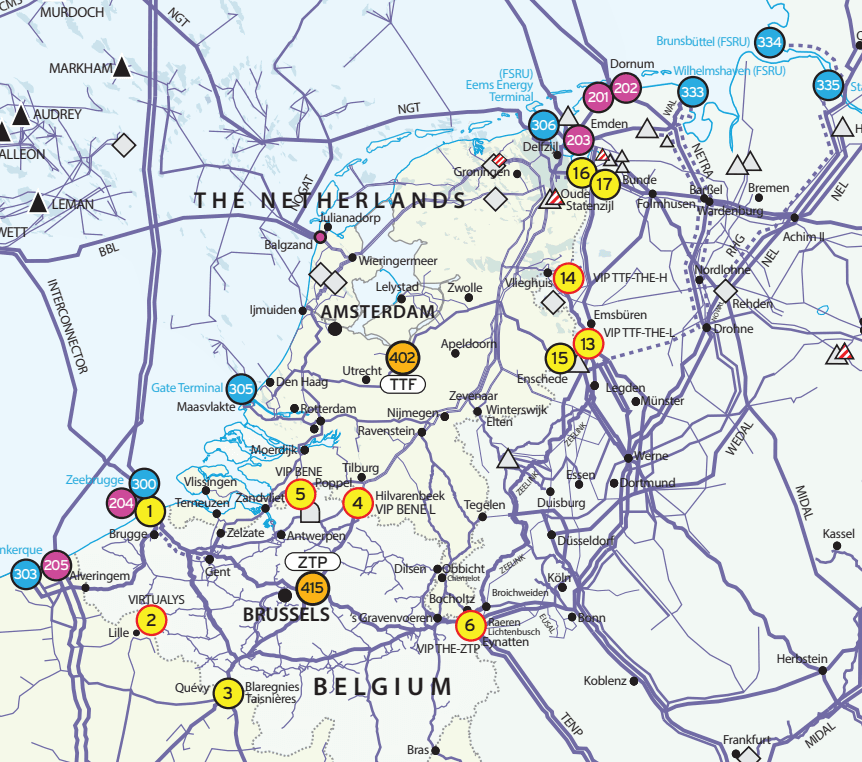
Gasunie GTS operates an entry/exit system across roughly 11,000 km of high-pressure pipelines connected to Belgium, Germany, Norway and the UK through BBL.
Cross-border capacity is offered at Virtual Interconnection Points, including VIP TTF-THE for Germany and VIP BENE for Belgium.
Capacity booking requires GTS recognition and a creditworthiness assessment. Capacity is booked through PRISMA.
Two LNG terminals serve the network, Gate (Rotterdam) and EemsEnergyTerminal (Eemshaven), both Gasunie affiliates. Capacity at both is fully contracted, so new entrants can only acquire firm capacity by buying rights from existing holders, or book interruptible capacity after registering as a Registered Customer: EUR 30,000 at Gate, EUR 25,000 at Eems. Terminals are grid entry points, so capacity must be booked by a licensed shipper.
Dutch Gas Market Exchange(s)
Europe's Leading VTP: The TTF, established in 2003, is the most liquid virtual trading point in Europe and the reference price for European spot gas (~64% of EU spot indexation as of October 2024).
The TTF is operated within the GTS network, and Gasunie administers TTF registration.
OTC-Dominated: Wholesale TTF trading is conducted mainly over the counter (bilaterally), often facilitated by broker/software platforms, alongside exchange trading.
Registration Requires a C-Licence: To register with the TTF, a company needs a subscription with Gasunie and at least a C-type licence (Trader recognition).
Exchange Operators: ICE Endex is the Ministry-appointed exchange operator for the Dutch gas market, with clearing through ECC.
ACM Oversight: The ACM supervises wholesale trading at the TTF given its impact on European energy prices.
5 Market Entry Steps for Dutch Gas Market
- 01Submit the GTS application and choose A, B or C recognition.
- 02Complete GTS creditworthiness assessment and provide financial security.
- 03Pass the Gasport or B2B communication test and complete EDSN market-role registration for B-type recognition.
- 04Obtain GTS recognition following review committee approval.
- 05Complete registration with the TTF through Gasunie; at least C-type recognition is required.
- Post-Market Entry Reporting Obligations.
CorreggioNET, Dutch Gas Market Access Report
Market Access Reports: CorreggioNET offers Pre-Market Entry Reports (PMER) as part of the PMER Library, providing firms with an A-to-Z guide for market entry.
CorreggioNET Alert Service: Helps you never miss a reporting obligation. Note that the Netherlands has several gas market reporting obligations across ACM, GTS and the tax authorities, combined with a highly dynamic gas market landscape.
CorreggioNET Hotline: For your time-sensitive queries, the Regulatory Hotline Service provides direct support through an online interaction with a qualified regulatory specialist.
Consulting Solutions: For those firms which require additional assistance, Correggio Consulting is on hand to assist with all your licensing needs:
- Market entry & registration in the Netherlands;
- GTS recognition (A / B / C licence);
- TTF onboarding;
- Corporate structuring;
- Exchange onboarding;
- EFET contract negotiation;
- Yearly compliance audits.

Market Info
Stay Compliant After Market Entry
Entering a new market is only the beginning.
Once trading activity starts, the real challenge is staying compliant with ongoing regulatory updates and reporting obligations. CorreggioNET supports this post-market entry stage through its regulatory platform and monitoring services.
See platform services