
Fast Facts
| Wholesale Trading Licence | No licence required; BRP onboarding via TenneT |
| Minimum Financial Resources | No fixed minimum; BRP financial security deposit of EUR 96,000 to TenneT ING account |
| Energy Permit Fee | EUR 1,199 one-off per permit for small-scale supply only |
| Required Codes | ACER under REMIT, EIC from ENTSO-E and EAN from GS1 |
| BRP Types | With grid connection, or trade-only (no grid connection) |
| Installed Capacity | Around 60 GW; renewables about 50% of generation |
Dutch Power Market Fundamentals
The Dutch electricity market is fully liberalised, regulated by ACM and operated by the single national TSO, TenneT.
The Netherlands operates as a single bidding zone. Electricity is traded across EPEX SPOT and Nord Pool for spot day-ahead and intraday trading, and ICE Endex for power derivatives.
Installed capacity stands around 60 GW, with generation around 120 TWh and renewable output around 60 TWh.
When Is a Licence Required in Dutch Power Market?
No ACM permit is required for wholesale electricity trading or supply to large-scale consumers. An ACM energy permit applies only to small-scale supply.
To trade wholesale electricity in the Netherlands, a company must be acknowledged by TenneT as a Balance Responsible Party, distinguishing BRPs with grid connections from trade-only BRPs without grid connections.
Foreign companies may apply directly; no local Dutch entity is required, though ACM advises engaging Dutch-speaking counsel.
What Are Dutch Power Market Licence Requirements for EU and Non-EU Entities?
EU and non-EU wholesale traders follow the same route: no local entity is required, foreign companies may apply directly.
ACER Code: required under REMIT for wholesale energy market participants, registered via CEREMP.
EIC (Energy Identification Code): issued by ENTSO-E via a Local Issuing Office, uniquely identifying participants in the European internal energy market.
EAN (European Article Number): a 13-digit Global Location Number obtained from GS1; all message exchange with TenneT systems is based on the EAN code.
All three codes must be secured before the agreement to access TenneT's network services, followed by TenneT BRP onboarding and registration with chosen exchanges.
Balancing in the Dutch Power Market
TenneT is responsible for system balancing and procuring ancillary services. Each BRP must balance its own portfolio on a quarter-hourly basis.
On D-1, each BRP submits a commercial trade schedule that must net to zero per settlement period; TenneT restores any imbalance within 15 minutes on delivery day, with settlement beginning at 10:00 on D+1.
Balancing Service Providers offer flexibility (FCR, aFRR, mFRR) to help TenneT restore frequency; FCR volumes are set annually by ENTSO-E.
Over 140 BRPs, around 30 accredited BSPs and around 65 congestion-management service providers participate in the market. TenneT participates in IGCC, TERRE, MARI and PICASSO for balancing energy and imbalance netting.
Transmission Capacity in the Dutch Power Market
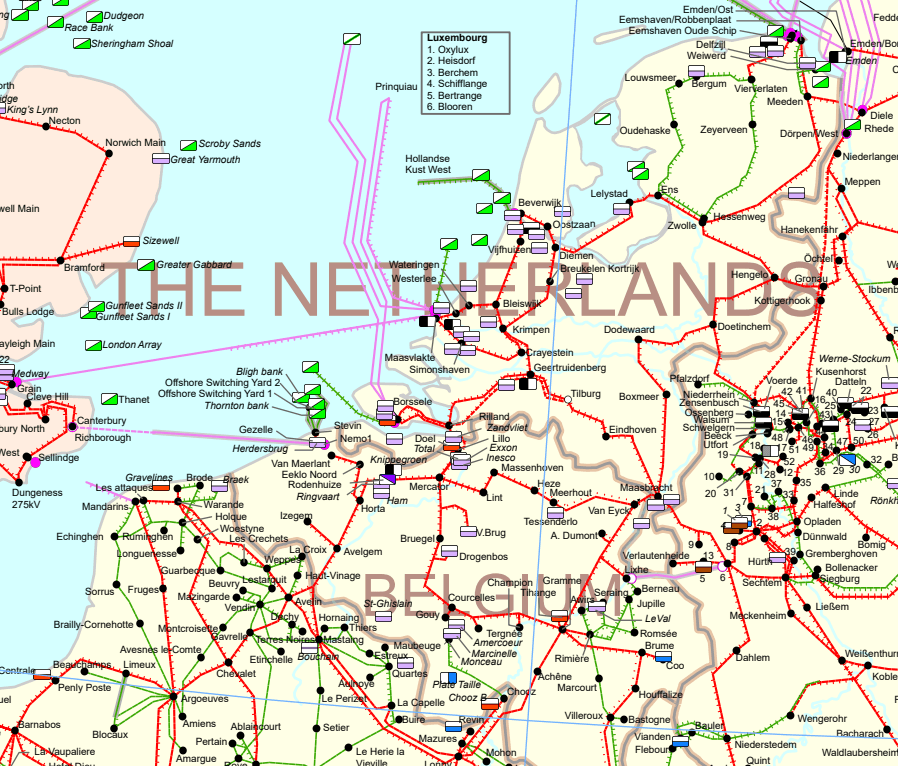
TenneT operates the Dutch high-voltage grid, with interconnections to Belgium, Germany, Great Britain, Denmark and Norway.
Cross-border day-ahead capacity is allocated through Single Day-Ahead Coupling, while intraday capacity is allocated through Single Intraday Coupling.
Dutch Power Market Exchange(s)
EPEX SPOT and Nord Pool: Both are designated Nominated Electricity Market Operators (NEMOs) offering day-ahead and intraday trading in the Dutch bidding zone.
Market Coupling: Both NEMOs participate in the Single Day-Ahead Coupling (SDAC) and Single Intraday Coupling (SIDC).
ICE Endex: Provides trading in Dutch power derivatives, including futures contracts and price-risk management products.
Spot Markets: Day-ahead auctions establish prices and schedules for the following delivery day, while intraday trading enables positions to be adjusted closer to delivery.
Admission Requirements: Market participants must separately satisfy the membership, contractual, technical and financial requirements of their chosen NEMO or exchange.



5 Market Entry Steps for Dutch Power Market
- 01Secure the three required codes: ACER, EIC and EAN.
- 02Submit the BRP Market Role Application to TenneT.
- 03Complete the TenneT IT qualification phase.
- 04Provide the EUR 96,000 financial security deposit to TenneT.
- 05Obtain BRP acknowledgement, go live and register with selected power exchanges.
- Post-Market Entry Reporting Obligations.
CorreggioNET, Dutch Power Market Access Report
Market Access Reports: CorreggioNET offers Pre-Market Entry Reports (PMER) as part of the PMER Library, providing firms with an A-to-Z guide for market entry.
CorreggioNET Alert Service: Helps you never miss a reporting obligation. Note that the Netherlands has multiple power market reporting obligations across ACM, TenneT and the tax authorities, combined with a power sector landscape in transition.
CorreggioNET Hotline: For your time-sensitive queries, the Regulatory Hotline Service provides direct support through an online interaction with a qualified regulatory specialist.
Consulting Solutions: For those firms which require additional assistance, Correggio Consulting is on hand to assist with all your licensing needs:
- Market entry & registration in the Netherlands;
- BRP acknowledgement (TenneT onboarding);
- Power exchange onboarding (EPEX SPOT / Nord Pool / ICE Endex);
- Corporate structuring;
- EFET contract negotiation;
- Yearly compliance audits.

Market Info
Stay Compliant After Market Entry
Entering a new market is only the beginning.
Once trading activity starts, the real challenge is staying compliant with ongoing regulatory updates and reporting obligations. CorreggioNET supports this post-market entry stage through its regulatory platform and monitoring services.
See platform services